Portable RGB Bluetooth Speaker Manufacturer: How Brands Combine Sound and Lighting
Portable RGB Bluetooth Speaker Manufacturer: How Brands Combine Sound and Lighting
Introduction
Portable Bluetooth speakers are no longer designed only around sound.
For many younger consumers, outdoor users, party users, and lifestyle buyers, visual experience has also become part of the product.
This is why more portable speaker brands are adding RGB lighting to products designed for:
Outdoor gatherings
Travel
Camping
Parties
Bedrooms
Student markets
Social media
Gift applications
For brands, importers, distributors, retailers, and Amazon sellers, RGB can help a portable speaker create stronger visual differentiation.
However, adding LEDs does not automatically create a good RGB Bluetooth speaker.
The lighting system needs to work together with:
Speaker acoustics
Battery capacity
Power management
Bluetooth
Waterproof structure
Industrial design
User controls
A professional portable RGB Bluetooth speaker manufacturer therefore needs to understand both audio engineering and lighting integration.
This guide explains how portable RGB speakers are designed, customized, tested, and manufactured for OEM and ODM brands.
What Is a Portable RGB Bluetooth Speaker?
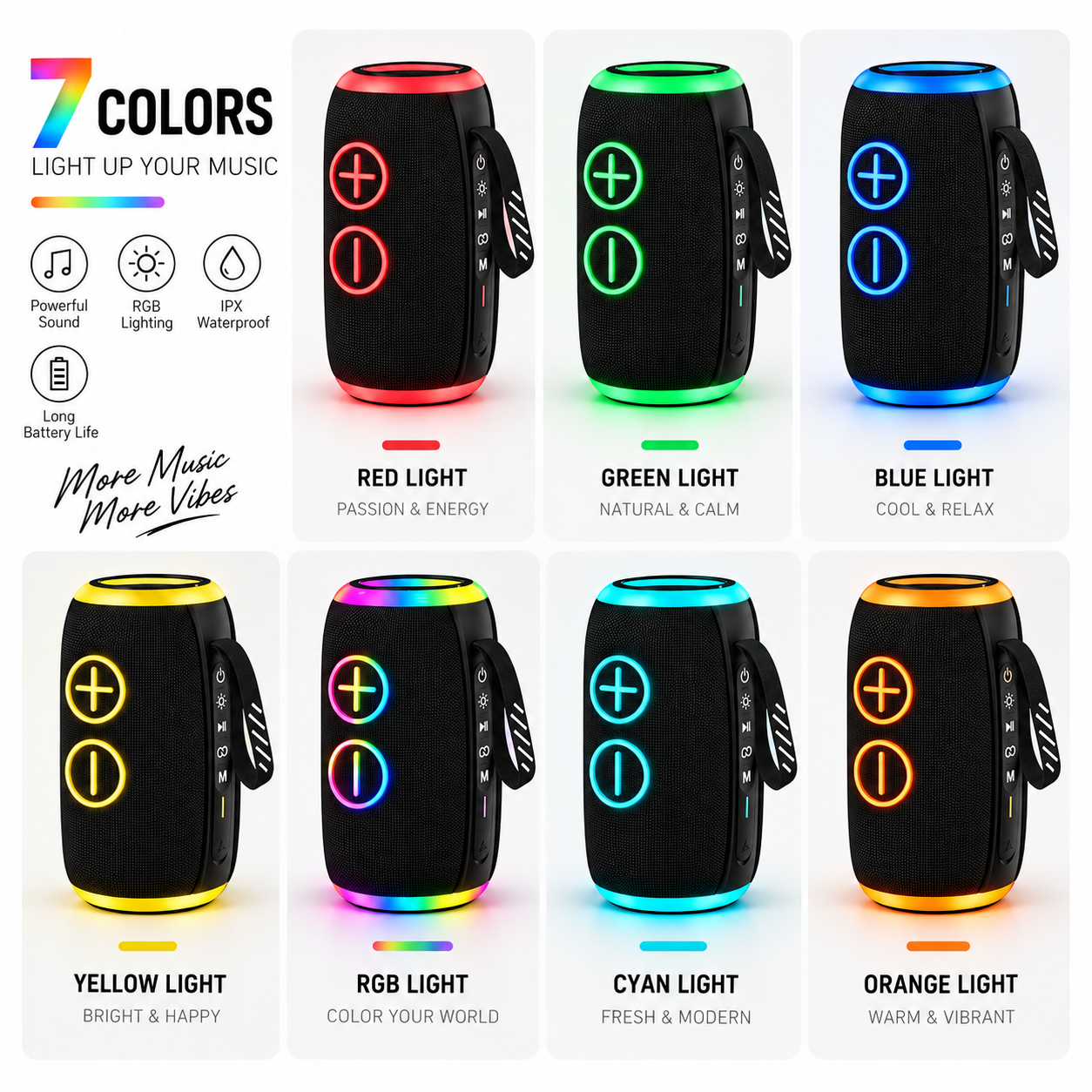
A portable RGB Bluetooth speaker combines wireless audio with integrated colored lighting.
The speaker typically includes:
Rechargeable battery
Bluetooth
Speaker drivers
Amplifier
RGB LEDs
Lighting controller
Charging system
Depending on the product, it may also support:
TWS
Waterproofing
USB-C charging
TF card
AUX
Microphone
Carry handle
Strap
App control
The key difference from a traditional portable speaker is that RGB lighting becomes part of the product experience.
Why RGB Matters in Portable Speakers
RGB can provide several benefits.
Stronger Visual Differentiation
Many Bluetooth speakers share similar:
Shapes
Materials
Functions
Specifications
Lighting gives brands another way to stand out.
Better Party Atmosphere
Dynamic lighting can make the speaker more suitable for:
Parties
Camping
Outdoor gatherings
Bedrooms
More Social-Media Appeal
RGB products are visually easier to demonstrate in:
Reels
TikTok videos
YouTube Shorts
Product advertising
The lighting effect can communicate product personality before the customer hears the sound.
Stronger Youth-Market Positioning
RGB often appeals to consumers interested in:
Gaming
Music
Lifestyle electronics
Colorful room setups
RGB Portable Speaker vs Standard Bluetooth Speaker
| Feature | Standard Portable Speaker | RGB Portable Speaker |
|---|---|---|
| Wireless audio | Yes | Yes |
| Rechargeable battery | Usually | Usually |
| Lighting experience | Limited or none | Strong |
| Party appeal | Moderate | Higher |
| Battery consumption | Lower | Higher |
| Design complexity | Lower | Higher |
| Social-media presentation | Standard | More visual |
| OEM differentiation | Moderate | Strong |
RGB adds value, but it also introduces additional engineering requirements.
How to Develop a Portable RGB Bluetooth Speaker
Step 1: Define the Target User
Before choosing lighting effects, brands should define who will buy the product. Possible customer groups include:
Party Users, Priorities:
Strong sound
Dynamic lighting
Long battery life
Easy carrying
Students, Priorities:
Attractive design
Affordable price
Bluetooth
RGB effects
Outdoor Users, Priorities:
Waterproofing
Durability
Battery life
Carry handle or strap
Gift Buyers, Priorities:
Appearance
Packaging
Easy operation
Brand customization
Different audiences require different RGB strategies.
Step 2: Define the RGB Positioning
Not every RGB speaker needs the same lighting system. Brands can choose between several levels.
Basic RGB
Possible functions:
Fixed colors
Simple color cycling
RGB on/off
Suitable for:
Entry-level products
Promotional speakers
Cost-sensitive markets
Dynamic RGB
Possible functions:
Multiple lighting modes
Breathing
Gradient effects
Music-reactive patterns
Suitable for:
Mainstream lifestyle products
Party speakers
Advanced RGB
Possible functions:
Multi-zone effects
Complex animation
App control
Customized brand lighting
Suitable for:
Premium products
Strong brand differentiation
The lighting system should match the target retail price.
Step 3: Choose RGB Placement
Lighting location strongly affects product appearance. Common options include:
Around the speaker driver
Behind the grille
Around passive radiators
Along cabinet edges
Under the speaker base
Around buttons
Inside logos
Different positions create different visual identities.
Driver-Ring RGB
Lighting around the driver is one of the most recognizable designs. Advantages include:
Highlights the audio system
Strong visual impact
Easy to see from the front
It works especially well for:
Party speakers
Youth-oriented products
Lifestyle speakers
RGB Behind the Grille
Lighting behind a fabric or metal grille can create a softer visual effect. Benefits include:
Premium appearance
Reduced visible LED points
Better integration with the product
The grille material needs to allow sufficient light transmission without negatively affecting sound.
Passive Radiator Lighting
Some portable speakers place RGB near passive radiators. This can visually emphasize the movement of the radiator during music playback. The combination of:
Bass Movement + RGB, can create a strong product demonstration effect. However, lighting should not interfere with mechanical movement.
Edge Lighting
RGB light strips can follow the shape of the enclosure. This can make the industrial design more recognizable. Edge lighting is particularly useful for products with:
Geometric shapes
Outdoor styling
Modern lifestyle positioning
Step 4: Design the Light Diffuser
LEDs alone rarely create premium lighting. A diffuser helps spread the light more evenly. Without proper diffusion, users may see:
Individual LED dots
Uneven brightness
Harsh hotspots
Manufacturers may use:
Transparent materials
Semi-transparent plastics
Light guides
Diffusion structures
The goal is smooth, controlled lighting.
RGB Diffusion and Product Quality. Lighting quality has a strong influence on perceived value. Two speakers may use similar LEDs, but one can look much more expensive because of better:
Diffuser design
LED spacing
Surface treatment
Light-guide structure
For OEM brands, this is an important differentiation opportunity.
Step 5: Select RGB Effects
Possible effects include:
Static color
Color cycling
Breathing
Gradient
Flashing
Rainbow
Music-reactive effects
The correct number of modes depends on the product. More modes do not automatically create a better user experience. Too many lighting options can make controls confusing.
Music-Reactive RGB, Some speakers can change lighting according to music. The lighting may respond to:
Rhythm
Volume
Frequency energy
This can strengthen party atmosphere.
However, the effect should be tuned carefully. If lighting reacts too aggressively or randomly, it can appear cheap rather than dynamic.
Step 6: Provide RGB Off Mode
RGB off mode is especially important in portable products. Why? Because lighting consumes battery power. Users may prefer to turn off RGB when:
Traveling
Using the speaker outdoors for long periods
Listening at night
Extending battery runtime
RGB off mode also broadens the product's appeal to users who sometimes prefer a more minimal appearance.
Step 7: Balance RGB and Battery Life
RGB LEDs require energy. A portable speaker battery may need to power:
Drivers
Amplifier
Bluetooth
DSP
RGB
Other electronics
The manufacturer must balance: Sound Output + Lighting Brightness + Playback Time. This is one of the most important engineering challenges in an RGB portable speaker.
Does RGB Reduce Playback Time? Yes, lighting can reduce battery runtime. The actual impact depends on:
Number of LEDs
Brightness
Lighting mode
Battery capacity
Amplifier power
Listening volume
Brands should test battery runtime under clearly defined conditions.
Step 8: Battery Selection
Battery capacity affects:
Playback time
Weight
Size
Cost
For RGB products, battery planning becomes even more important. A battery that performs well in a non-RGB version may provide noticeably shorter runtime when strong lighting is added.
Step 9: Charging System
Portable RGB speakers commonly use rechargeable lithium batteries. Charging design may include:
USB-C
Charging indicators
Battery protection
The manufacturer should verify:
Charging current
Temperature
Battery protection
Charging time
USB-C describes the connector and does not automatically mean fast charging.
Step 10: Speaker Driver Selection
RGB is visually important, but audio remains the core function. Driver selection should be based on:
Product size
Target output
Battery
Cabinet volume
Target sound
The RGB structure should not reduce the space needed for proper acoustic performance.
Step 11: Passive Radiators
Passive radiators are common in portable Bluetooth speakers because they can support low-frequency performance in compact enclosures. They may also become visual design elements.
Brands should understand that passive radiator performance depends on:
Active driver
Cabinet volume
Radiator parameters
Tuning
Visible vibration alone does not automatically mean superior bass.
Step 12: Acoustic Chamber Design
The internal enclosure needs sufficient acoustic integrity. Engineers must consider:
Driver chamber
RGB components
Battery placement
PCB
Passive radiator
Sealing
Adding RGB hardware can reduce internal space. Therefore, lighting should be integrated early rather than added after the acoustic structure has been completed.
Step 13: Bluetooth Integration
Bluetooth is the primary connection for most portable speakers. Manufacturers should test:
Pairing
Reconnection
Stability
Antenna performance
Device compatibility
RGB electronics should not create unnecessary interference with wireless performance. PCB and antenna placement therefore require careful planning.
Step 14: TWS
TWS allows two compatible portable speakers to connect together.
Benefits may include:
Wider sound
Larger coverage
Stronger party experience
For RGB speakers, manufacturers may also consider whether lighting behavior should remain visually coordinated between the two products.
Step 15: Waterproof Design
Many portable RGB speakers target outdoor use. This creates an additional challenge: How do you create visible lighting while maintaining water resistance?
Potential areas requiring sealing include:
RGB windows
Charging port
Buttons
Housing joints
Grilles
Waterproof structure should be considered during industrial design.
RGB Windows and Waterproofing. Transparent lighting areas create additional housing interfaces. These interfaces may require:
Sealing structures
Adhesives
Gaskets
Controlled assembly
A visually attractive RGB window should not become the weakest point in the waterproof system.
Step 16: Outdoor Durability
Portable speakers may experience:
Drops
Dust
Water
Heat
Frequent handling
Materials may include:
ABS
Silicone
Fabric mesh
Metal grille
The combination should support both:
Visual appearance
Durability
Step 17: Carry Handle or Strap
RGB speakers designed for outdoor use often benefit from a clear carrying solution. Possible options include:
Integrated handle
Silicone strap
Fabric strap
Lanyard
The carrying structure can also become part of the product's visual identity.
Step 18: Control Design
Common controls include:
Power
Volume
Play/pause
Bluetooth
TWS
RGB
Brands should decide whether RGB control needs:
Separate button
Combined button
App control
Simple controls usually create a better user experience.
Step 19: Industrial Design
RGB should support the shape of the product. A good design integrates:
Lighting
Grille
Driver
Buttons
Handle
Logo
The lighting should feel like part of the product rather than an LED strip added at the final stage.
Step 20: Brand-Specific RGB Identity
Brands can use lighting to create recognizable design language. Examples include:
A signature startup color
Specific RGB animation
Illuminated logo
Consistent lighting across product families
This can help build a recognizable audio ecosystem.
Step 21: RGB and Product Families
A brand can develop several speakers using a shared lighting language. For example:
Mini Speaker
Small RGB ring
Portable Outdoor Speaker
Large side lighting
Party Speaker
Multi-zone RGB
The products can look different while still feeling like part of one brand.
Step 22: Logo Customization
Branding options may include:
Printed logo
Laser logo
Metal badge
Molded logo
Illuminated logo
An illuminated logo can integrate branding directly into the RGB system.
Step 23: Housing Colors
RGB appearance changes depending on housing color. For example:
Black Housing
Can create:
Strong contrast
Gaming feel
Nighttime visual impact
White Housing
Can create:
Lifestyle appearance
Softer lighting reflection
Modern design
Brands should evaluate lighting on actual colored samples rather than only digital renderings.
Step 24: Packaging
RGB speaker packaging should communicate the lighting experience clearly. Useful visual elements may include:
Product image with RGB active
Lighting mode icons
Bluetooth
TWS
Waterproof rating where applicable
Battery information
The packaging should not exaggerate lighting beyond what the actual product can reproduce.
Packaging for E-Commerce
For Amazon and other online channels, RGB can become a strong listing feature. Brands can use:
Lifestyle images
Night scenes
Party scenarios
Feature graphics
However, packaging must still prioritize:
Protection
Shipping size
Cost
Step 25: Prototype Validation
Before production, evaluate both sound and lighting.
Check:
Sound
Bass
Clarity
Maximum volume
Distortion
RGB
Brightness
Color consistency
Diffusion
Effects
Controls
Battery
Runtime with RGB on
Runtime with RGB off
Charging
Bluetooth
Pairing
Stability
Reconnection
Step 26: RGB Consistency Testing
Lighting should be inspected across multiple units.
Check:
Color consistency
LED brightness
Diffuser appearance
Animation behavior
Differences between units can reduce perceived product quality.
Step 27: Music-Reactive Lighting Testing
If lighting reacts to music, test different content types.
Examples include:
Electronic music
Pop
Rock
Speech
Low-volume music
The effect should remain attractive across different audio content.
Step 28: Battery Runtime Testing
Brands should compare:
RGB on
RGB off
Different listening volumes
This provides more realistic information for product specifications.
Avoid using theoretical battery calculations as final consumer claims without validation.
Step 29: Waterproof Testing
If a waterproof rating is claimed, the final production configuration should be validated accordingly.
RGB-related components such as:
Light windows
Buttons
Housing joints
should be included in the waterproof assessment.
Step 30: Quality Control
Quality control for portable RGB Bluetooth speakers may include:
Audio testing
Bluetooth testing
Battery testing
Charging testing
RGB inspection
Button testing
TWS testing
Waterproof checks where applicable
Appearance inspection
RGB adds another visual system that must remain consistent in mass production.
OEM vs ODM Portable RGB Speakers
ODM
Uses an existing speaker platform.
Common customization:
Logo
Color
Packaging
Selected lighting settings
Best for:
Faster launch
Market testing
Private label
Semi-Custom
Can reuse:
PCB
Acoustic structure
Drivers
while customizing:
Housing
Light diffuser
RGB effects
Carry structure
Full OEM
May include:
New industrial design
Custom PCB
Custom lighting architecture
New tooling
Custom firmware
Brand-specific RGB effects
The correct development level depends on volume, budget, timeline, and brand strategy.
Portable RGB Speaker MOQ
MOQ depends on:
Existing or custom platform
Housing color
RGB structure
Packaging
Electronics
Tooling
There is no universal MOQ suitable for every project.
A simple logo and packaging customization may have different requirements from a completely new RGB design.
Portable RGB Speaker Cost Factors
Major cost factors may include:
Drivers
Battery
Bluetooth chipset
Amplifier
RGB LEDs
Diffuser
PCB
Waterproof structure
Housing
Packaging
Advanced multi-zone lighting generally creates more cost and development complexity than basic RGB.
How to Compare RGB Speaker Suppliers
Do not compare suppliers only by:
Wattage
Battery capacity
Number of LEDs
Unit price
Buyers should also evaluate:
Sound quality
RGB diffusion
Battery runtime
Bluetooth stability
Waterproof structure
Production consistency
Engineering support
Two products with similar specifications can create very different user experiences.
Portable speakers for different markets
Portable RGB Speakers for Amazon Sellers
Amazon sellers should focus on benefits that are easy to demonstrate. Examples include:
Dynamic RGB
TWS
Waterproofing
Portable handle
Long battery life
RGB is especially useful because it can create strong:
Main images
Videos
Lifestyle content
However, reliability remains critical because RGB-related failures can quickly generate negative reviews.
Portable RGB Speakers for Importers
Importers may prioritize:
Broad consumer appeal
Competitive pricing
Stable quality
Multiple colors
Packaging options
A proven ODM platform can reduce launch risk while still allowing visual customization.
Portable RGB Speakers for Lifestyle Brands
Lifestyle brands may focus more heavily on:
Product shape
Color
Lighting aesthetics
Packaging
The speaker should feel like part of a broader lifestyle collection rather than only an electronic device.
Common RGB Speaker Mistake:
Common RGB Speaker Mistake 1: Adding Too Many LEDs
More LEDs increase:
Power consumption
Cost
Heat
PCB complexity
The goal should be better visual design, not simply more LEDs.
Common RGB Speaker Mistake 2: Poor Diffusion
Visible LED dots can make an otherwise premium product look inexpensive.
Common RGB Speaker Mistake 3: Ignoring Battery Runtime
Lighting brightness should be balanced with realistic playback expectations.
Common RGB Speaker Mistake 4: No RGB Off Mode
Users should have the option to prioritize battery life or use the speaker in environments where lighting is unnecessary.
Common RGB Speaker Mistake 5: Treating Lighting as the Only Selling Point
The speaker still needs:
Good sound
Stable Bluetooth
Reliable battery
Durable construction
RGB should enhance the product, not hide weak fundamentals.
Common RGB Speaker Mistake 6: Adding RGB After Acoustic Design
Lighting hardware consumes internal space.
It should be considered together with:
Drivers
Battery
PCB
Passive radiator
from the beginning.
🏭 Real Factory Insight
A successful portable RGB speaker needs two experiences to work at the same time: It needs to sound good when your eyes are closed and It needs to look attractive before the music even starts.
The challenge is that both systems compete for the same:
Internal space
Battery
PCB area
Product cost
For example: Increasing LED brightness may reduce battery runtime. Adding a larger light diffuser can reduce internal acoustic volume. Adding more lighting zones can require a more complex PCB and firmware system.
Professional product development therefore does not ask:
“How many RGB effects can we add?”
It asks:
“How can lighting create stronger customer value without damaging sound, battery life, or product reliability?”
That balance is what separates integrated RGB design from decorative lighting.
Buyer Decision Checklist
Before requesting an OEM or ODM portable RGB speaker quotation, define:
Target customer
Target market
Target retail price
Product size
Target sound
Driver configuration
Battery requirement
Playback target
RGB placement
RGB modes
RGB off mode
Music-reactive lighting
TWS
Bluetooth
Waterproof requirement
Carry handle or strap
Housing color
Logo
Packaging
First-order quantity
Expected annual volume
Target launch date
A clear product brief allows the manufacturer to balance sound, lighting, battery, and cost more effectively.
Why Choose Shinedee
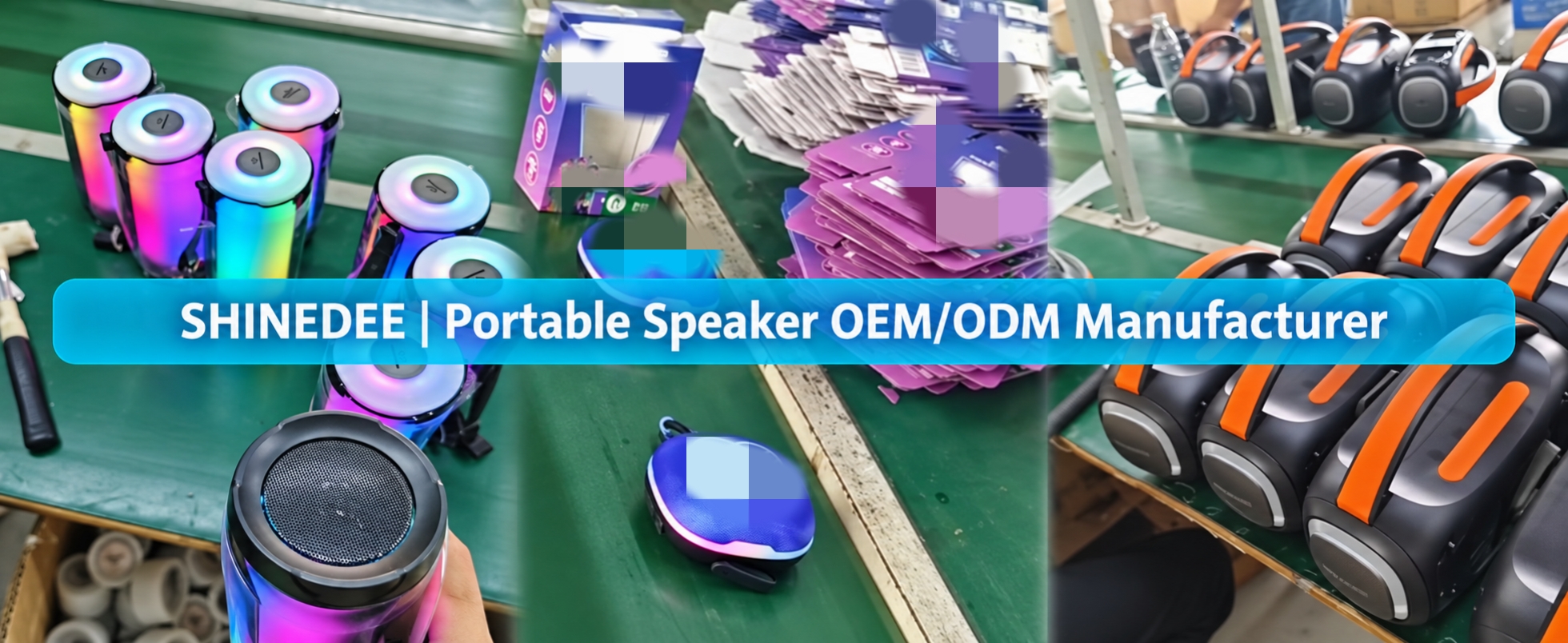
Shenzhen Shinedee Electronics develops and manufactures RGB audio products for global brands, importers, retailers, distributors, and online sellers.
Our capabilities include:
Portable RGB Bluetooth speaker manufacturing
Portable speaker OEM and ODM
RGB lighting development
Lighting-effect customization
Acoustic tuning
Driver selection
Bluetooth integration
TWS functionality
Battery integration
Waterproof structure development
Industrial design support
Branding
Packaging customization
Product testing
Quality control
Mass production
Our product categories include:
Portable RGB Bluetooth Speakers
Outdoor Waterproof Bluetooth Speakers
Mini Bluetooth Speakers
RGB Gaming Speakers
Gaming Soundbars
Founded in 2010, Shinedee supports customers from product concept and customization through acoustic development, lighting integration, sample validation, testing, packaging, and stable mass production.
👉read more: Portable Speaker Manufacturer | OEM & ODM Bluetooth Speaker Factory
Conclusion
Portable RGB Bluetooth speakers combine two important consumer experiences:
Audio
Visual atmosphere
For brands, RGB creates opportunities to differentiate products through:
Lighting effects
Product shape
Illuminated branding
Party applications
Social-media-friendly design
However, RGB should never be developed independently from the rest of the speaker. A successful product requires balance between:
Sound
Battery
Bluetooth
Lighting
Waterproofing
Portability
Cost
For new brands, existing ODM platforms can provide a faster route to market. For growing brands, semi-custom RGB development can create stronger differentiation. For established brands, full OEM development can support exclusive lighting architecture, industrial design, firmware, and long-term product families. Shinedee supports global customers with OEM and ODM portable RGB Bluetooth speaker solutions—from acoustic engineering and RGB development through battery integration, waterproof design, testing, packaging, quality control, and mass production.