When Should You Request Quotes, Approve Samples and Start Production for Christmas Speaker Orders?
When Should You Request Quotes, Approve Samples and Start Production for Christmas Speaker Orders?
Christmas is in December, but a speaker order intended for holiday retail usually needs to arrive much earlier. Brands and retailers still need time to receive stock, distribute it across warehouses and stores, launch product listings and prepare promotions. If your campaign starts in October or November, a shipment arriving in December may miss the most useful selling window.
The most practical way to plan is to work backward from the date the stock must reach your warehouse. Allow time for local distribution, international freight, production and inspection, sample approval and the initial request for quotation (RFQ). The schedule below is an example for planning, not a guaranteed lead time. Your destination, shipping method, order size and customization requirements will change the dates.
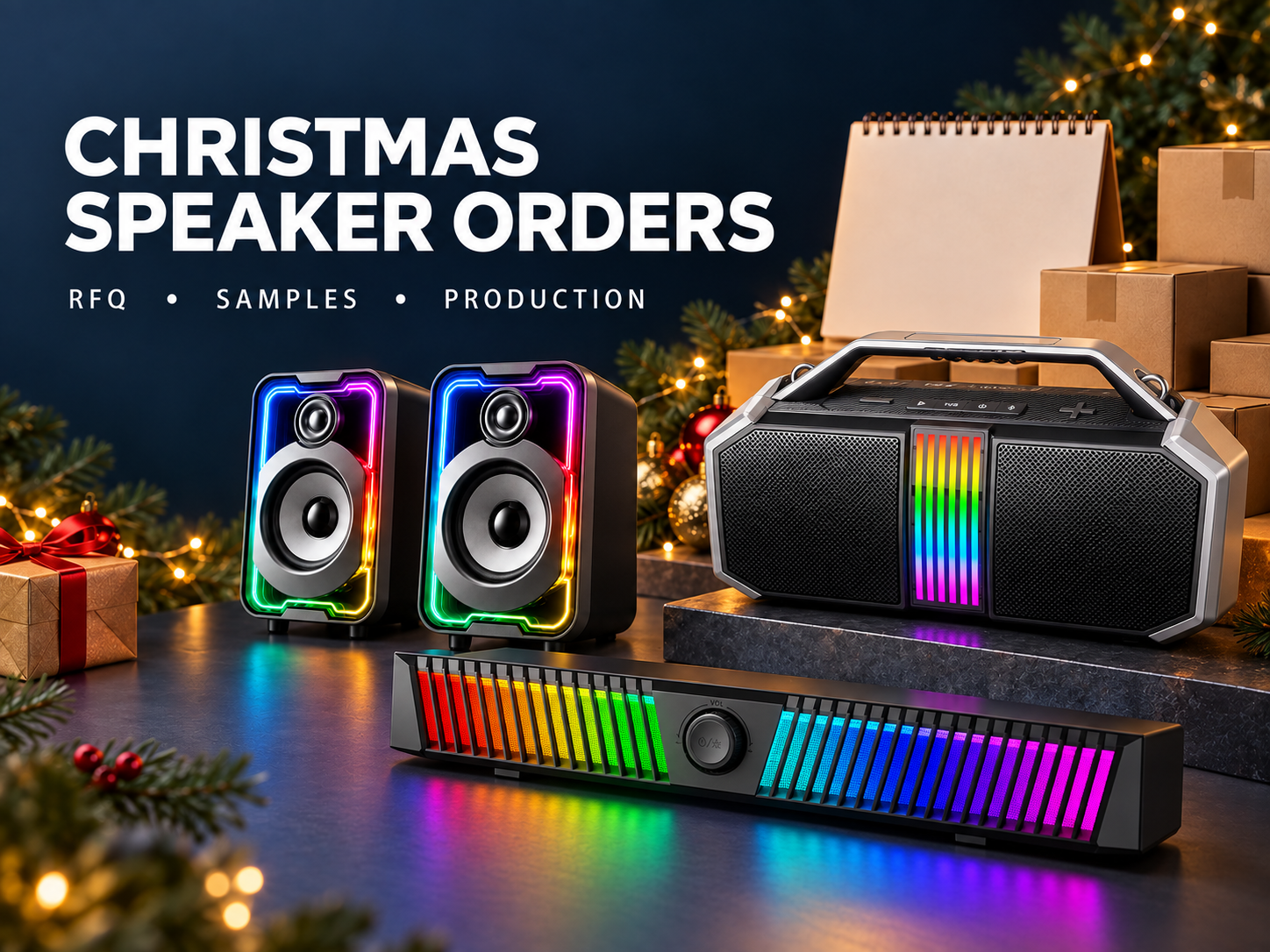
Start with the warehouse deadline
Suppose your Christmas speaker range needs to be ready for retail in late October. First, agree on the date the goods must arrive at the receiving warehouse. From there, check how long the retailer needs for labeling, inventory allocation, store delivery and online listings.
For an imported order, the shipping plan must cover more than time at sea. Booking, origin handling, customs clearance, collection at the destination port and final delivery all take time. Build a buffer for changes in sailing schedules, too. DHL’s retail peak season overview describes planning that begins as early as January, with some seasonal stock moving by ocean freight in summer and promotions starting in October.
A sample timeline for a late October retail launch
This example assumes sourcing from China, shipping mainly by sea and aiming to place products in retail channels by late October. Confirm each milestone with your manufacturer and freight partner for your specific market.
| Stage | Planning window | What to complete |
|---|---|---|
| Product brief and RFQ | January–March | Define the target market, retail price, estimated volume, product types and customization scope; request quotations and proposals. |
| Samples and evaluation | March–May | Test sound, controls, battery performance, appearance and packaging; document changes and approve the final samples. |
| Purchase order and materials | May–June | Confirm the final specifications, artwork, manuals, purchase order and production schedule. |
| Mass production and inspection | June–August | Monitor materials, assembly, quality checks, packing and export documentation. |
| Freight and retail delivery | August–October | Arrange shipping, customs clearance, warehouse receipt and distribution to retail channels. |
These are milestone windows, not fixed dates for every buyer. A late change to the gift box, for instance, can affect dispatch even if the speaker itself is ready.
RFQ stage: describe the products you actually want to sell
A useful RFQ covers more than unit price. Tell the supplier where the speakers will be sold, your estimated quantity, required warehouse date and expected level of customization. Changing only the logo and box is a different project from altering color, lighting, sound, buttons or the enclosure.Also explain the role of each product in the holiday range. A portable gift speaker, a karaoke model with microphones and a desktop gaming speaker need different evaluations, packaging and price targets.
For desktop gaming products, define the form factor first. If you want a compact black 2.0 USB stereo speaker with RGB lighting and Bluetooth connectivity, specify whether those features are standard or optional. A desktop gaming soundbar for wholesale may instead need dynamic RGB lighting and an easy-to-use volume control. Clear distinctions help the supplier quote the right configurations and estimate sample and production time.
For an outdoor gift range, you might request a black 20W portable Bluetooth speaker and set IPX6 water resistance as a target. Ask how output and water resistance will be tested, and how those requirements affect price and timing. They are RFQ targets until the sample and test results confirm the final specification; they should not be treated as verified claims for an unapproved model.
If you plan to ship several models together, share the quantities, carton sizes and packaging requirements early so the container and delivery plan can be checked before booking.
Sampling stage: approve the product and the retail pack
When the sample arrives, test it as a buyer or customer would use it. Check sound quality at low and high volumes, pairing and controls, lighting, charging and battery performance. If the package will state a water resistance rating or other measurable performance claim, review the supporting test results before approving the wording.
The sales package also needs sign-off. Check product photos, languages, barcode placement, included accessories and the manual. More than one sample round may be needed, so allow time for feedback, revisions and final approval. Approve both the product sample and the packaging sample before using them as the production standard.
Production stage: distinguish factory completion from retail delivery
After the purchase order is confirmed, the factory still has to source materials, schedule production, assemble, inspect and pack the goods. Agree on checkpoints you can track: materials ready, first-article approval, production progress, final inspection and the date the shipment is ready for handover.
If your range includes several speaker models or packaging languages, track each version separately. One delayed component or carton can hold back a combined shipment.
Clarify the trade terms and handover point as well. “Production completed by the end of August” is not the same as “stock delivered to the retailer by the end of August.” Factory completion, inspection, freight booking and destination delivery need separate dates on the project schedule.
What if you start in late September?
Starting an RFQ in late September for that year’s Christmas sales leaves a much tighter schedule. Whether the order can still work depends on the availability of an existing model, the amount of customization, the destination, the shipping method and, most of all, the actual warehouse deadline. A new mold, several acoustic revisions or fresh performance testing will need more time than a previously approved configuration.
Ask the supplier which existing models and production slots are available. Keep any customization within options that have already been validated, then ask your freight partner to check departures and realistic warehouse arrival dates. Air freight may be an option for a small, urgent quantity, but cost and carrier conditions need a separate assessment. If the receiving deadline cannot be met, revise the launch plan before committing to an unverified delivery date.
As a time-specific example, Maersk’s September 2026 Asia Pacific market update advises customers with fourth-quarter cargo needs to review sailing schedules and space requirements early and allow extra lead time. Last-minute feasibility always depends on the route and capacity available when the booking is made.
Keep one shared schedule
Your brand team, manufacturer and freight partner should work from the same four dates: required warehouse arrival, final sample approval, production completion and planned shipment departure. Whenever a specification, packaging design or quantity changes, check whether the later dates still hold.
For a customized speaker range entering overseas retail by sea, requesting quotes early in the year, approving samples in spring and moving into production and shipping in summer gives the project a manageable sequence. The decisive factor is confirming each milestone and leaving sufficient time for freight and retail receiving.
How Shinedee supports Christmas speaker sourcing
Shinedee is a Shenzhen-based speaker manufacturer focused on OEM and ODM projects. We work with brands, importers and retail buyers to select portable, gaming and party speaker options for their target markets and launch dates. Depending on the project, we can coordinate samples and support customization of logos, colors, RGB lighting, sound and retail packaging.
After the sample and order are confirmed, we review the final specifications, packaging, quantities and delivery milestones with the customer, then coordinate production and pre-shipment inspection. If you are planning a Christmas speaker range, email your required warehouse date, estimated order quantity and customization brief to nicoley@shinedee.com so we can assess suitable options and a workable schedule together.