Portable Karaoke Speaker Manufacturer: OEM Guide for Music & Lifestyle Brands
Portable Karaoke Speaker Manufacturer: OEM Guide for Music & Lifestyle Brands
Introduction
Portable karaoke speakers are becoming a distinct category between traditional Bluetooth speakers and large party speakers. Instead of requiring a large trolley cabinet or complicated karaoke system, modern portable karaoke speakers can combine:
Bluetooth music playback
Built-in rechargeable battery
One or two wireless microphones
RGB lighting
Portable handles
TWS
Voice effects
Compact packaging
This makes them suitable for:
Home entertainment
Family gatherings
Small parties
Outdoor picnics
Travel
Student markets
Gifts
Social-media-driven lifestyle products
For brands, importers, distributors, retailers, and online sellers, portable karaoke speakers offer an opportunity to combine entertainment, audio, and lifestyle positioning in one product.
However, developing a successful karaoke speaker requires more than simply adding a microphone to a Bluetooth speaker.
The manufacturer needs to coordinate:
Music playback
Microphone audio
Feedback control
Wireless microphone connection
Battery
Speaker drivers
RGB
Controls
Portability
This guide explains how portable karaoke speakers are designed, customized, tested, and manufactured through OEM and ODM projects.
What Is a Portable Karaoke Speaker?
A portable karaoke speaker is a rechargeable speaker that supports both:
Music playback
Vocal microphone input
Unlike a standard Bluetooth speaker, it allows users to sing along with music. Depending on the product, the system may include:
One wireless microphone
Two wireless microphones
Bluetooth
USB-C charging
RGB lighting
TWS
TF card playback
AUX
Voice effects
Echo adjustment
Carry handle
The main goal is to create an easy karaoke experience without requiring professional audio equipment.
Portable Karaoke Speaker vs Standard Bluetooth Speaker
| Feature | Standard Portable Speaker | Portable Karaoke Speaker |
|---|---|---|
| Bluetooth music | Yes | Yes |
| Rechargeable battery | Usually | Usually |
| Wireless microphone | Usually no | Yes |
| Vocal mixing | No | Yes |
| Echo effects | Usually no | Often available |
| RGB lighting | Optional | Common |
| Party use | Moderate | Strong |
| Family entertainment | General | Strong |
| Product complexity | Lower | Higher |
The microphone system makes the karaoke speaker a more complex product.
Why Portable Karaoke Speakers Are Attractive for Brands
1. More Than a Music Speaker
A standard Bluetooth speaker mainly solves one need:
Play music.
A karaoke speaker adds participation.
Users can:
Sing
Perform
Play with friends
Entertain children
Create videos
This creates more usage scenarios.
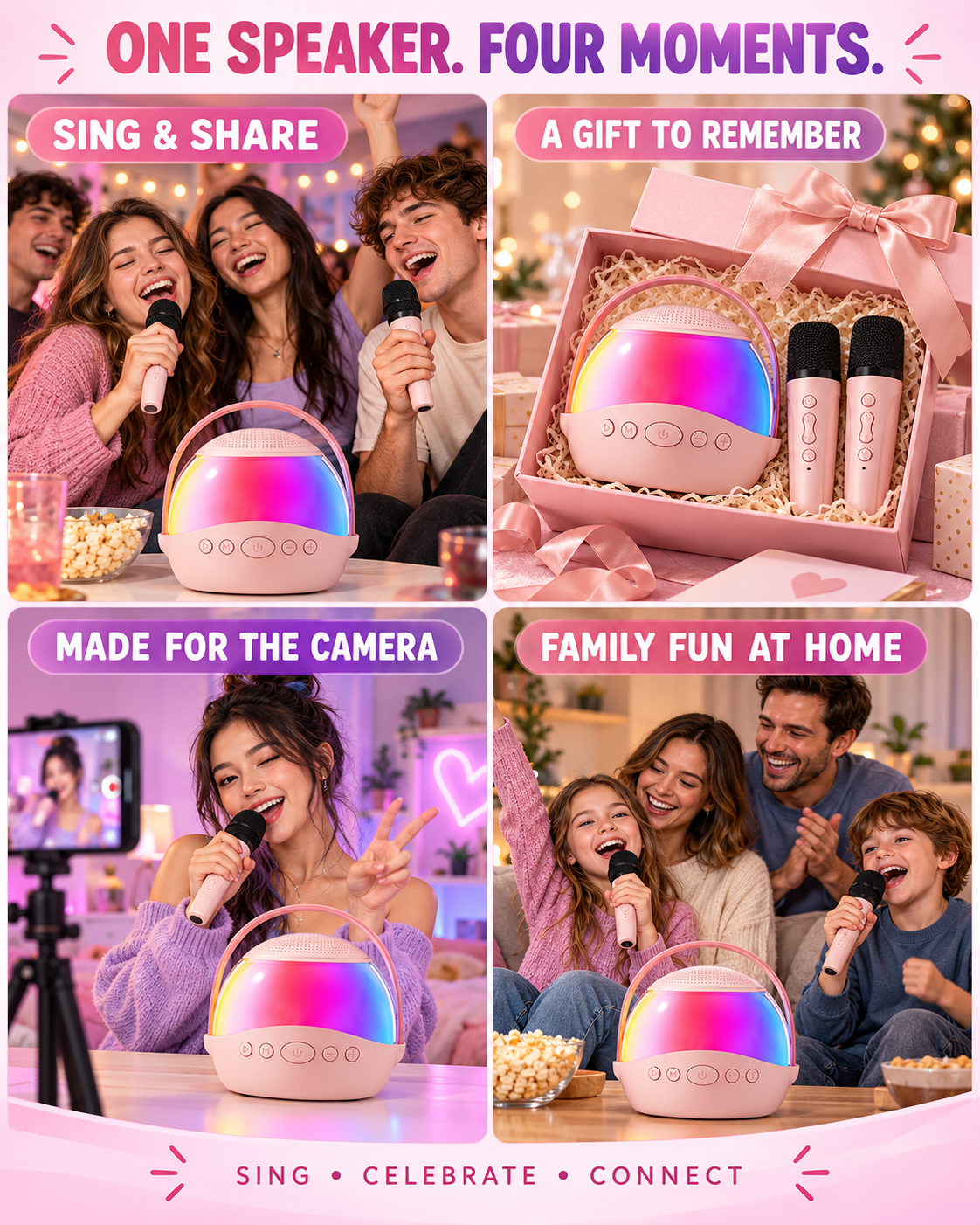
2. Strong Gift Potential
Portable karaoke speakers can work well as gifts because they combine:
Entertainment
Music
Visual appeal
Interactive use
They may be suitable for:
Birthdays
Holidays
Corporate gifts
Family gifts
Student gifts
Packaging can further strengthen the gift positioning.
3. Social-Media-Friendly Product
A karaoke speaker is easy to demonstrate in short-form video.
Content can show:
Opening the box
Turning on RGB
Connecting Bluetooth
Picking up the microphone
Singing
The product's benefit can be communicated visually within seconds.
4. Lifestyle Positioning
Portable karaoke speakers do not need to look like traditional professional karaoke equipment.
They can use:
Modern colors
Rounded shapes
Transparent elements
RGB
Fabric
Decorative grilles
This allows brands to position them as lifestyle electronics.
Portable Karaoke Speaker Development Guide: 30 Key Steps from User Needs to Mass Production
Step 1: Define the Target User
The first question should be:
Who will use the karaoke speaker?
Possible target users include:
Young Consumers
Priorities:
Attractive design
RGB
Wireless microphone
Easy Bluetooth connection
Families
Priorities:
Easy operation
Two microphones
Safe volume
Reliable battery
Students
Priorities:
Affordable price
Compact size
Fun voice effects
Outdoor Users
Priorities:
Battery life
Portability
Durable housing
Handle
Gift Buyers
Priorities:
Attractive packaging
Simple operation
Strong visual presentation
The target user determines the correct product architecture.
Step 2: Define the Product Size
Portable karaoke speakers can range from very small personal products to larger compact party models.
Size influences:
Driver selection
Battery
Microphone storage
RGB area
Handle design
Packaging
The product should remain easy to carry while providing enough internal volume for acceptable sound performance.
Step 3: Select the Driver System
The speaker driver is still the core of the product.
Driver selection affects:
Music quality
Vocal reproduction
Maximum volume
Bass
Cabinet dimensions
Karaoke speakers need to reproduce both:
Music
Human voice
This creates different tuning requirements from a speaker designed only for background music.
Music and Vocal Balance
A karaoke speaker should not allow the background music to completely overpower the singer.
At the same time, vocals should not sound:
Thin
Harsh
Unnatural
Manufacturers may tune the system to create a practical balance between music and vocal reproduction.
Step 4: Wireless Microphone System
Wireless microphones are one of the most important differences between karaoke speakers and standard portable speakers.
A complete microphone system may involve:
Microphone transmitter
Speaker receiver
Microphone capsule
Battery
Controls
Wireless communication
The system should provide reliable connection within the intended user range.
One Microphone vs Two Microphones
One Microphone
Suitable for:
Personal singing
Entry-level products
Compact packaging
Advantages include:
Lower cost
Simpler system
Smaller package
Two Microphones
Suitable for:
Duets
Family entertainment
Parties
Social use
Two microphones can create a stronger karaoke proposition but also add:
Cost
Packaging space
Charging requirements
Testing complexity
Step 5: Microphone Sound Quality
Microphone quality affects the entire karaoke experience.
Important factors include:
Voice clarity
Sensitivity
Distortion
Background noise
Handling noise
A cheap microphone can make an otherwise good speaker feel low quality. Brands should evaluate microphone performance together with speaker performance.
Step 6: Microphone Volume
Users may need separate control of:
Music volume
Microphone volume
This allows them to balance the singer with the background music. Entry-level products may use simpler automatic mixing.
More advanced products may provide dedicated microphone controls. The correct approach depends on product positioning.
Step 7: Echo Function
Echo is commonly used in karaoke because it can make vocals feel fuller.
Possible control strategies include:
Fixed echo
Several preset levels
Adjustable echo
Too much echo can reduce vocal clarity. Therefore, more echo is not necessarily better. The effect should be tuned for the target user.
Step 8: Voice Effects
Lifestyle-oriented karaoke speakers may include fun vocal effects.
Examples can include:
Higher pitch
Lower pitch
Character-style voices
These can be attractive for:
Children
Young consumers
Parties
Social content
However, every additional effect requires:
Firmware
User controls
Testing
Brands should avoid unnecessary complexity.
Step 9: Feedback Control
Microphone feedback can occur when amplified sound re-enters the microphone and creates a loud ringing or howling sound.
The risk can depend on:
Microphone position
Speaker volume
Microphone gain
User distance
Acoustic tuning
Portable karaoke products should be designed and tested with realistic microphone use. User instructions can also help customers avoid holding the microphone too close to the speaker.
Step 10: Bluetooth Music Playback
Bluetooth remains the main music source for many portable karaoke speakers.
Users can connect:
Smartphone
Tablet
Laptop
Then play karaoke tracks or normal music.
Important areas include:
Pairing
Reconnection
Connection stability
Antenna design
The microphone wireless system and Bluetooth system should also operate reliably together.
Step 11: Bluetooth and Microphone Coexistence
A karaoke speaker may contain multiple wireless systems.
For example:
Bluetooth for music
Wireless microphone connection
Engineers need to consider:
Antenna placement
PCB layout
Wireless coexistence
Interference
This is one reason why adding a microphone system is more complex than simply adding another accessory.
Step 12: TWS
TWS may allow two compatible karaoke speakers to connect together for music playback.
Potential benefits include:
Wider sound
Larger party coverage
However, karaoke functions can create additional complexity.
Manufacturers should clearly define how:
Microphones
TWS
Music playback
behave when two speakers are paired.
Step 13: Battery Capacity
Battery capacity affects:
Playback time
Karaoke time
Product weight
Cost
The battery may need to power:
Amplifier
Bluetooth
Microphone receiver
RGB
DSP
Karaoke operation can therefore have different power requirements from normal Bluetooth music playback.
Step 14: USB-C Charging
USB-C can provide a familiar charging interface. However, USB-C only describes the connector.
The actual charging performance depends on:
Charging IC
Battery
Charging current
Power source
Brands should clearly communicate supported charging behavior.
Step 15: RGB Lighting
RGB can strongly reinforce the karaoke and party experience.
Lighting can appear:
Around drivers
Behind the grille
Around the housing
Under the speaker
Around controls
Possible effects include:
Static colors
Color cycling
Breathing
Music-reactive lighting
Music-Reactive Lighting
Lighting synchronized with music can help create a stronger entertainment experience. However, the visual response should be tuned carefully.
Poorly controlled lighting may appear:
Random
Too fast
Distracting
The effect should support the music rather than compete with it.
Step 16: RGB Off Mode
An RGB-off function gives users more flexibility.
They may turn lighting off when:
Saving battery
Using the speaker during the day
Preferring a simpler appearance
This makes the product suitable for both entertainment and normal Bluetooth listening.
Step 17: Portability
A portable karaoke speaker should still be easy to carry despite additional:
Microphones
Battery
Electronics
Possible carrying solutions include:
Integrated handle
Strap
For smaller models, compactness may be more important. For medium products, a strong handle can improve usability.
Step 18: Handle Design
A handle should consider:
Product weight
Center of gravity
Finger clearance
Grip comfort
If the battery or drivers make one side significantly heavier, handle position should compensate for the weight distribution.
Step 19: Outdoor Use
Portable karaoke speakers can be used for:
Camping
Picnics
Outdoor gatherings
Barbecues
Brands targeting these scenarios may consider:
Stronger housing
Water resistance
Carry handle
Longer battery
However, product claims should match actual engineering and validation.
Step 20: Waterproofing
Adding wireless microphones does not prevent a speaker from using a water-resistant design.
However, engineers may need to protect:
Charging port
Buttons
Housing joints
Microphone storage areas
The desired protection level should be considered early during mechanical design.
Step 21: Product Controls
A karaoke speaker may require more controls than a standard portable speaker.
Functions may include:
Power
Music volume
Microphone volume
Bluetooth
RGB
Echo
Voice effects
TWS
Control design should remain intuitive.
Too many buttons can confuse users.
Step 22: Control Simplification
Manufacturers can combine functions using:
Short press
Long press
Multi-function buttons
However, excessive multi-function behavior can also become difficult to remember.
For consumer products, simple and visible controls are often preferable.
Step 23: Industrial Design
Portable karaoke speakers can use many visual styles. Possible directions include:
Youth Lifestyle
Bright colors
Rounded housing
RGB
Outdoor
Rugged housing
Large handle
Dark colors
Premium Lifestyle
Cleaner shape
Refined materials
Controlled lighting
The design should match the consumer rather than automatically copying traditional party speakers.
Step 24: Housing Materials
Possible materials include:
ABS
Silicone
Fabric
Metal grille
Material selection can affect:
Appearance
Durability
Cost
Acoustic behavior
Waterproofing
Step 25: Housing Color
Color can be particularly important for lifestyle karaoke products.
Possible strategies include:
Black
White
Pink
Blue
Green
Brand colors
Multiple colors can support different consumer groups, but they also increase inventory complexity.
Step 26: Logo Customization
Branding options may include:
Printing
Laser marking
Molded logo
Metal badge
Illuminated logo
The appropriate method depends on:
Housing material
Product positioning
Project volume
Step 27: Microphone Branding
The microphones can also become part of the brand identity.
Customization may include:
Logo
Color
Surface finish
A speaker and microphone set should feel like one coordinated product rather than unrelated components.
Step 28: Packaging Design
Portable karaoke speakers require packaging that organizes:
Speaker
One or two microphones
Charging cables
Manuals
The customer should immediately understand where each component is located. A well-organized package improves the unboxing experience.
Gift Packaging
Because karaoke speakers have strong gift potential, packaging can become an important selling point.
Possible options include:
Color gift box
Carry-style box
Premium inserts
Lifestyle artwork
The packaging should match the target retail price.
E-Commerce Packaging
Amazon and online sellers should pay attention to:
Package dimensions
Product protection
Microphone protection
Accessory organization
Shipping cost
A compact karaoke speaker can lose its logistics advantage if the microphone packaging creates excessive empty space.
Step 29: Sample Evaluation
Before placing a production order, buyers should test:
Music
Bass
Clarity
Maximum volume
Microphones
Voice quality
Connection stability
Volume
Echo
Bluetooth
Pairing
Reconnection
Stability
Battery
Music runtime
Karaoke runtime
Charging
RGB
Effects
Controls
Battery impact
Step 30: Real Karaoke Testing
Do not evaluate the product only with music playback.
Use real users to:
Connect smartphones
Play karaoke tracks
Sing
Use both microphones
Adjust volume
Walk around the room
This can reveal problems that standard factory audio testing may not show.
Microphone Range Testing
Wireless microphone performance should be tested in realistic environments.
Manufacturers can evaluate:
Connection stability
Voice interruptions
Working distance
Actual performance depends on:
Antenna
Environment
Wireless design
Brands should avoid using exaggerated range claims without validation.
Microphone Battery Testing
If microphones use rechargeable batteries, test:
Runtime
Charging
Low-battery behavior
Reconnection after charging
A microphone that stops working much earlier than the speaker can negatively affect the karaoke experience.
Quality Control
Portable karaoke speaker QC may include:
Music playback
Driver inspection
Bluetooth
Microphone connection
Microphone audio
Echo
Voice effects
RGB
Battery
Charging
Controls
Packaging
The complete speaker-and-microphone system should be tested together.
Aging Testing
Depending on the quality plan, products may undergo aging tests to identify early failures involving:
Amplifier
Bluetooth
RGB
Electronics
Microphone systems may also require separate functional checks.
OEM vs ODM Portable Karaoke Speakers
ODM
Uses an existing manufacturer platform.
Suitable for:
Faster launch
Private-label brands
Market testing
Typical customization may include:
Logo
Color
Packaging
Semi-Custom
May reuse:
PCB
Acoustic system
Microphone solution
while customizing:
Housing
RGB
Controls
Handle
Packaging
Full OEM
May include:
New industrial design
New tooling
Custom PCB
Custom acoustics
Customized microphone system
Custom firmware
The correct development model depends on the brand's strategy.
Portable Karaoke Speaker MOQ
There is no universal MOQ.
It may depend on:
Speaker platform
Microphones
Housing color
Packaging
Electronics
Tooling
A simple private-label project can have very different requirements from a completely new OEM development.
Portable Karaoke Speaker Cost Factors
Cost can be influenced by:
Drivers
Amplifier
Battery
Bluetooth
Wireless microphones
Microphone batteries
DSP
RGB
Housing
Packaging
The microphone system is an important part of the total cost.
How to Compare Karaoke Speaker Quotations
When comparing suppliers, verify whether quotations include the same:
Number of microphones
Microphone quality
Battery
Driver system
Bluetooth
RGB
Packaging
A quotation with two rechargeable wireless microphones cannot be compared directly with a simpler one-microphone product.
Protable Karaoke Speakers for different sales channel
Portable Karaoke Speakers for Amazon Sellers
E-commerce sellers can differentiate through visible benefits such as:
Two wireless microphones
Compact size
RGB
Carry handle
Voice effects
These functions are easy to demonstrate through:
Photos
Videos
Short-form content
However, buyers should also pay attention to return risks caused by:
Microphone pairing
Charging confusion
Complicated controls
Clear instructions are important.
Portable Karaoke Speakers for Retailers
Retail buyers may prioritize:
Attractive packaging
Easy demonstrations
Clear functionality
Broad family appeal
A product that can be demonstrated quickly in store may be easier for customers to understand.
Portable Karaoke Speakers for Gift Markets
Gift-oriented products should focus on:
Appearance
Simple controls
Attractive packaging
Easy setup
Complex professional karaoke functions may not be necessary. The product should feel fun immediately after opening the box.
Portable Karaoke Speakers for Young Consumers
Younger consumers may respond strongly to:
RGB
Color options
Voice effects
Compact shape
Two microphones
However, brands should avoid adding features purely for specification competition. The product still needs to be easy to use.
Common karaoke Speaker Mistakes:
Common Karaoke Speaker Mistake 1: Focusing Only on Speaker Wattage. The microphone experience is just as important as music output.
Common Karaoke Speaker Mistake 2: Using Low-Quality Microphones. A weak microphone can reduce customer satisfaction even if the speaker sounds good.
Common Karaoke Speaker Mistake 3: Too Much Echo. Excessive vocal effects can make speech unclear.
Common Karaoke Speaker Mistake 4: Complicated Controls. Users should be able to start karaoke quickly.
Common Karaoke Speaker Mistake 5: Ignoring Microphone Storage. Portable products should consider where users store the microphones.
Common Karaoke Speaker Mistake 6: Ignoring Battery Balance. The speaker may still have power while the microphone battery is already empty. Both systems should be evaluated together.
Common Karaoke Speaker Mistake 7: Oversized Packaging. Two microphones can create unnecessary packaging volume if the internal structure is poorly designed.
🏭 Real Factory Insight
A portable karaoke speaker is actually several products working together:
Bluetooth Speaker + Wireless Microphone System + Mixer + Battery Product
This means a sample can pass normal Bluetooth speaker testing and still provide a poor karaoke experience.
For example:
Music sounds good.
Bluetooth is stable.
RGB looks attractive.
But when the user starts singing:
Microphone volume is too low
Echo is too strong
Feedback appears
One microphone disconnects
The product is now unsuccessful even though the speaker itself works.
That is why karaoke products should be tested as complete entertainment systems.
The most important question is not:
“Does the speaker work?”
It is:
“Can a customer open the box and enjoy karaoke easily?”
Buyer Decision Checklist
Before requesting a portable karaoke speaker quotation, confirm:
Target customer
Target market
Target retail price
Speaker size
Driver configuration
Target output
Battery requirement
One or two microphones
Microphone battery type
Microphone storage
Microphone volume control
Echo requirement
Voice effects
Bluetooth
TWS
RGB
RGB off mode
Waterproof requirement
Handle
Housing color
Branding
Packaging
First-order quantity
Expected annual volume
Target launch date
A clear product brief helps manufacturers balance sound, karaoke functions, portability, cost, and user experience.
Why Choose Shinedee
Shenzhen Shinedee Electronics develops and manufactures portable audio products for global brands, importers, distributors, retailers, and online sellers.
Our capabilities include:
Portable karaoke speaker OEM and ODM
Portable Bluetooth speaker manufacturing
Wireless microphone integration
Acoustic tuning
Driver selection
Battery integration
Bluetooth development
TWS functionality
RGB customization
Industrial design support
Handle and portability design
Branding
Packaging customization
Product testing
Quality control
Mass production
Our product categories include:
Portable Karaoke Speakers
Portable Bluetooth Speakers
Mini Bluetooth Speakers
Portable RGB Speakers
Outdoor Waterproof Speakers
Gaming Audio Products
Founded in 2010, Shinedee supports customers from product selection and concept development through acoustic engineering, sample validation, packaging, quality control, and mass production.
Frequently Asked Questions
Can microphone volume be adjusted separately? Yes, depending on the product design. Some models provide separate microphone volume or echo controls, while simpler products may use preset settings.
What is echo in a karaoke speaker? Echo is an audio effect that adds repeated or extended vocal sound, helping vocals feel fuller during karaoke.
Can karaoke speakers have voice-changing effects? Yes. Depending on the DSP and firmware, lifestyle-oriented products may support different voice effects.
Can a portable karaoke speaker be waterproof? Water-resistant designs are possible depending on the enclosure, ports, buttons, and product architecture. The intended protection level should be verified through appropriate testing.
Does karaoke use more battery than normal music playback? It can, because additional systems such as microphone receivers, vocal processing, and RGB may consume power. Runtime should be tested under realistic usage conditions.
What determines portable karaoke speaker MOQ? MOQ depends on the existing product platform, microphones, housing color, packaging, components, tooling, and customization requirements.
Is ODM suitable for a new karaoke speaker brand? Yes. A proven ODM platform can help reduce development time and initial risk while still allowing branding and selected customization.
What should buyers test before bulk ordering? Test music quality, microphone sound, microphone connection, echo, Bluetooth, battery, charging, RGB, controls, packaging, and real karaoke usage.
Conclusion
Portable karaoke speakers combine audio with interactive entertainment.
Compared with a standard Bluetooth speaker, they add:
Wireless microphones
Vocal mixing
Echo
Voice effects
Karaoke-focused controls
while maintaining the portability expected from modern Bluetooth audio products.
For brands, this creates opportunities in:
Family entertainment
Youth markets
E-commerce
Gifts
Outdoor activities
Lifestyle electronics
However, a successful product requires the speaker and microphone system to work together reliably.
Brands should evaluate:
Music quality
Vocal performance
Microphone connectivity
Battery
RGB
Portability
Packaging
Ease of use
For new brands, an existing ODM platform can provide a practical path into the market. For growing brands, semi-custom development can create stronger differentiation. For established brands, full OEM development can support unique industrial design, acoustics, microphones, RGB systems, and product families.
Shinedee supports global customers with OEM and ODM portable karaoke speaker solutions—from speaker and microphone integration through acoustic tuning, battery development, RGB customization, testing, packaging, quality control, and mass production.