Portable Party Speaker vs Personal Bluetooth Speaker: Product & Market Differences
Portable Party Speaker vs Personal Bluetooth Speaker: Product & Market Differences
Introduction
“Portable Bluetooth speaker” is a broad product category. A compact wireless speaker for personal listening and a larger Bluetooth model for outdoor gatherings can both be portable, but they require different design priorities. However, they are very different products. A personal Bluetooth speaker usually focuses on:
Compact size
Easy carrying
Personal listening
Travel
Everyday use
A portable party speaker usually focuses on:
Higher sound output
Stronger bass
Group entertainment
RGB lighting
Karaoke or microphone functions
Longer outdoor use
For brands, importers, retailers, distributors, and Amazon sellers, understanding this difference is important because the two categories require different:
Product specifications
Target customers
Pricing
Packaging
Marketing
Sales channels
OEM strategies
This guide explains the major product and market differences between portable party speakers and personal Bluetooth speakers.
What Is a Personal Bluetooth Speaker?
A personal Bluetooth speaker is primarily designed for individual or small-group listening.
Typical usage includes:
Bedroom music
Study
Travel
Small picnics
Office use
Hotel rooms
Personal outdoor activities
The main design priorities are usually:
Compact dimensions
Lightweight construction
Battery efficiency
Simple Bluetooth operation
Easy carrying
Depending on the product, it may also include:
TWS
RGB
Waterproofing
Strap
Clip
USB-C charging
What Is a Portable Party Speaker?
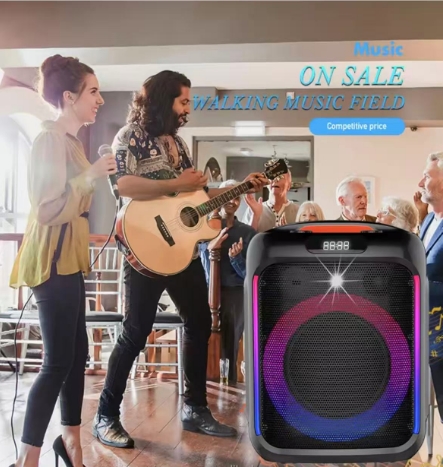
A portable party speaker is designed for more social and entertainment-focused listening.
Typical usage includes:
Outdoor gatherings
Family parties
Camping
Barbecues
Picnics
Small events
Karaoke
Common features may include:
Higher audio output
Larger drivers
Stronger bass
Larger battery
RGB lighting
Carry handle
TWS
Wireless microphone support
Karaoke functions
The product remains portable, but portability is balanced against stronger audio performance.
Quick Comparison
| Feature | Personal Bluetooth Speaker | Portable Party Speaker |
|---|---|---|
| Main user | Individual / small group | Group entertainment |
| Size | Small to medium | Medium to large |
| Weight | Lower | Higher |
| Sound output | Moderate | Higher |
| Bass potential | Moderate | Stronger |
| Battery size | Smaller | Usually larger |
| RGB | Optional | Common |
| Microphones | Rare | Often available |
| Karaoke | Rare | Common |
| Carry design | Strap / clip | Handle / strap |
| Packaging | Compact | Larger |
| Retail price | Entry to mid-range | Mid to higher |
| Main scenario | Personal / travel | Party / outdoor |
The categories overlap, but their priorities are different.
Explaination of the differences between personal bluetoot speaker and portable party speaker
1. Target Customer
The most important difference is the customer.
Personal Speaker Customer
May include:
Students
Travelers
Office users
Young consumers
Casual listeners
They often care about:
Size
Price
Convenience
Battery
Appearance
Party Speaker Customer
May include:
Families
Outdoor groups
Party users
Karaoke users
Camping consumers
They may care more about:
Output
Bass
Battery
Lighting
Microphone functionality
Product development should begin with these customer differences.
2. Personal vs Group Listening
Personal Bluetooth speakers are generally designed for close-range listening. Examples include:
Desk
Bedroom
Tent
Hotel room
Portable party speakers need to cover a larger listening area.
This can influence:
Driver size
Amplifier output
Cabinet volume
Battery consumption
A product designed for five or ten people requires a different acoustic strategy from a speaker designed for one person.
3. Product Size
Personal speakers generally prioritize compact dimensions. Consumers may expect them to fit:
Backpack
Handbag
Luggage
Party speakers can be larger because users accept additional size in exchange for stronger performance. However, they should still remain manageable enough to carry.
4. Weight
Personal speakers should generally be lightweight.
Party speakers may weigh more because they contain:
Larger drivers
Bigger batteries
Larger cabinets
More structural material
The challenge is ensuring that the party speaker remains genuinely portable.
5. Carrying Design
Personal speakers commonly use:
Strap
Clip
Lanyard
Party speakers more commonly use:
Integrated handle
Large strap
The carrying solution should match the final product weight. A larger battery or driver system can significantly change carrying comfort.
6. Driver Configuration
Personal Bluetooth speakers may use:
One full-range driver
Two compact drivers
Passive radiator
Party speakers may use:
Larger drivers
Multiple drivers
Dedicated high-frequency elements
Larger passive radiators
However, more drivers do not automatically mean better sound. The complete acoustic system matters.
7. Sound Output
Party speakers typically aim for higher sound output because they serve:
Larger rooms
Outdoor gatherings
Group listening
Personal speakers usually focus more on:
Near-field listening
Moderate volume
Battery efficiency
Brands should define the real listening environment before deciding the required output.
8. Wattage
Wattage is commonly used to separate portable speaker categories.
However:
Higher wattage does not automatically mean better sound.
Actual performance also depends on:
Driver efficiency
Cabinet
Amplifier
DSP
Distortion
A 20W portable speaker is not automatically “twice as loud” as a 10W model.
9. Bass Performance
Party users often expect stronger bass. Larger cabinets provide greater flexibility for:
Larger drivers
Passive radiators
Bass-reflex structures
Personal speakers can still provide enjoyable bass, but physical size creates limits. Manufacturers should avoid unrealistic bass claims for extremely compact products.
10. Acoustic Tuning
The sound profile may also differ.
Personal Speaker possible tuning direction:
Balanced
Clear vocals
Comfortable everyday listening
Party Speaker possible tuning direction:
Stronger bass
Greater impact
Higher perceived energy
The correct tuning depends on target users.
11. Battery Capacity
Personal speakers generally have less internal space for batteries. Party speakers can often accommodate larger batteries. However, larger party products also consume more power because of:
Higher audio output
RGB
Microphone receivers
DSP
Battery capacity alone should not be used to predict playback time.
12. Playback Time
Runtime depends on:
Battery capacity
Volume
Amplifier efficiency
RGB
Wireless functions
A smaller speaker operating at medium volume may sometimes achieve very practical runtime despite having a smaller battery. Brands should use defined test conditions for battery claims.
13. Charging
Both categories increasingly use USB-C charging. But USB-C is only the connector type.Actual charging performance depends on:
Battery
Charging IC
Charging current
Power architecture
Larger party speakers may require a more powerful charging system.
14. Bluetooth
Bluetooth is fundamental in both categories. Manufacturers should optimize:
Pairing
Reconnection
Stability
Antenna
The Bluetooth version alone does not determine final user experience.
15. TWS
TWS can be valuable for both products. Personal Speaker TWS Allows two small speakers to create:
Wider stereo
Stronger combined sound
Party Speaker TWS Can support:
Larger listening areas
Bigger outdoor setups
TWS reliability should be tested under real conditions.
16. RGB Lighting
RGB is optional in personal speakers but increasingly common in party products.
For personal speakers, RGB may focus on:
Lifestyle
Youth appeal
Decorative lighting
For party speakers, RGB may become part of the entertainment experience.
Possible effects include:
Music-reactive lighting
Dynamic color modes
Driver-ring lighting
17. RGB and Battery Consumption
Lighting consumes energy. This is especially important for party speakers with:
Large lighting areas
Multiple LED zones
Brands should test runtime with:
RGB on
RGB off
This provides more useful battery information.
18. Karaoke Functions
Karaoke is one of the clearest differences between the categories. Personal speakers rarely require microphone systems.
Portable party speakers may support:
One wireless microphone
Two wireless microphones
Echo
Voice effects
This transforms the product from a playback device into an entertainment system.
19. Wireless Microphones
Wireless microphones add:
Hardware
Battery
Wireless receiver
Packaging
Testing
A party speaker with microphones therefore requires a more complex development process. Microphone quality should be evaluated together with music playback.
20. Waterproofing
Both categories may target outdoor users. Personal waterproof speakers may be used for:
Hiking
Beach
Poolside
Party speakers may be used for:
Camping
Barbecues
Outdoor gatherings
The appropriate water resistance depends on the intended scenario. If a buyer specifies IPX6 water resistance for an outdoor model, the final design—including its ports and seals—should be tested against that requirement. Claims should match validated product performance.
21. Product Durability
Personal speakers may experience:
Backpack movement
Drops
Frequent carrying
Party speakers may experience:
Outdoor transport
Heavier impact
More frequent placement on rough surfaces
Different usage creates different mechanical priorities.
22. Industrial Design
Personal speakers often emphasize:
Compact shape
Lifestyle colors
Simple controls
Party speakers may emphasize:
Large drivers
Visible passive radiators
RGB
Strong handles
More aggressive styling
Industrial design should immediately communicate the intended use. A black housing may suit a restrained outdoor range, while brighter colors and visible RGB can give a party model a different look.
23. Control Complexity
A personal speaker may need only:
Power
Volume
Play/pause
Bluetooth
A party speaker may also need:
RGB
TWS
Microphone
Echo
Input switching
More functions require a carefully designed user interface.
24. Packaging Size
Personal speakers usually provide an important logistics advantage:
Small retail boxes
More units per carton
Easier warehousing
Party speakers require larger packaging due to:
Larger cabinet
Handle
Microphones
Accessories
Packaging should therefore be included in product economics.
25. Shipping Cost
Personal speakers often have lower:
Sea freight volume
Air freight volume
Parcel cost
Party speakers may cost significantly more to transport. Brands should compare: Factory Price + Freight + Fulfillment rather than factory price alone.
26. Amazon Strategy
Personal speakers can be attractive on Amazon because of:
Compact packaging
Lower fulfillment cost
Broad consumer demand
Party speakers can differentiate through:
Strong RGB
Karaoke
Higher output
Two microphones
However, larger packaging may significantly affect fulfillment economics.
27. Retail Strategy
Personal speakers require less shelf space.
This allows retailers to display:
More models
More colors
Party speakers take more space but can create stronger visual impact.
Retailers may use demonstrations to show:
Bass
RGB
Karaoke
28. Distributor Strategy
Distributors should evaluate local consumer behavior. In some markets, consumers may prefer:
Affordable compact speakers
In others, larger speakers with:
RGB
Karaoke
Higher output
may have stronger demand. The local channel matters.
29. Retail Price
Personal speakers commonly occupy lower or mainstream price points.
Party speakers may support higher retail prices because of:
Larger components
Higher output
Bigger batteries
Microphone functions
But higher prices also create higher expectations.
30. Product Margin
A higher retail price does not automatically mean a higher margin.
Party speakers can create higher costs through:
Components
Packaging
Shipping
Fulfillment
Returns
Brands should calculate total landed and operating economics.
Different Strategies
Personal Bluetooth Speaker OEM Strategy
For a personal product, prioritize:
Compact dimensions
Battery efficiency
Bluetooth stability
Portable carry structure
Packaging efficiency
Useful differentiators may include:
TWS
RGB
Waterproofing
Unique shape
Portable Party Speaker OEM Strategy
For a party product, prioritize:
Audio output
Bass
Battery
RGB
Handle
Karaoke
Depending on positioning, brands may also add:
Two microphones
TWS
Voice effects
The feature set should remain manageable.
Private Label Strategy
Existing ODM products can help new brands test both categories. For personal speakers, customization may include:
Logo
Color
Packaging
For party speakers, it may also include:
RGB modes
Microphone branding
Handle colors
This reduces initial development risk.
Semi-Custom Strategy
Semi-custom projects can reuse:
PCB
Drivers
Acoustic platform
while customizing:
Housing
RGB
Handle
Colors
Packaging
This creates stronger differentiation without developing every component from zero.
Full OEM Strategy
Full OEM can be considered when:
Market demand is proven
Exclusive design matters
Existing products cannot meet requirements
Development can involve:
New housing
Tooling
Acoustic engineering
PCB
Firmware
RGB
The customization should create clear commercial value.
Which Category Is Better for New Brands?
For many new brands, personal Bluetooth speakers can provide:
Lower inventory risk
Smaller packaging
Easier logistics
However, they also face intense competition. Portable party speakers can provide stronger feature differentiation through:
Karaoke
RGB
Larger sound
but require more investment. There is no universal answer.
Which Category Is Better for Outdoor Brands?
Outdoor brands may use both. For example:
Personal Outdoor Speaker For:
Hiking
Travel
Beach
Portable Party Speaker For:
Camping
Group activities
Barbecues
The two products can serve different moments in the same customer's lifestyle.
Which Category Is Better for Gift Markets?
Personal speakers are often suitable for:
Corporate gifts
Promotional programs
Smaller budgets
Portable karaoke and party speakers may be suitable for:
Premium gifts
Holiday gifts
Family entertainment
Packaging should match the gift positioning.
Building a Portable Speaker Product Ladder
Brands can create a clear portfolio:
Level 1: Mini Speaker
Focus: Maximum portability
Level 2: Personal Portable Speaker
Focus: Everyday audio
Level 3: Mainstream Outdoor Speaker
Focus: Outdoor versatility
Level 4: Portable Party Speaker
Focus: Group entertainment
This helps brands cover multiple price and usage segments.
Common mistakes
Common Mistake 1: Calling Every Speaker “Party Speaker”: A small personal speaker with RGB does not automatically become a party speaker. Product positioning should match actual sound and usage.
Common Mistake 2: Choosing Party Speakers Only by Wattage: A strong party product also needs:Bass, Battery, Portability, Reliability
Common Mistake 3: Ignoring Logistics: Large packaging can significantly affect profitability.
Common Mistake 4: Making Party Speakers Too Heavy: If users struggle to carry the product, “portable” becomes a weak claim.
Common Mistake 5: Adding Karaoke to Every Model: Microphones add cost and complexity. Not every party speaker needs karaoke.
Common Mistake 6: Making Personal Speakers Feature-Heavy:
A personal speaker may perform better commercially with:
Simple Bluetooth
Good battery
Good sound
than with many rarely used functions.
🏭 Real Factory Insight
A common product-selection mistake is asking: Which speaker is better?
A more useful question is: Better for what?
Imagine two products.
Speaker A:
Compact
Lightweight
10-hour-class usage target
Easy backpack carrying
Speaker B:
Larger drivers
Bigger battery
RGB
Two microphones
Speaker B may look much more impressive in a specification table. But for a traveler, Speaker A may be the better product. For a family party, Speaker B may be the better product.
OEM development should therefore begin with the usage scenario, not with the longest feature list.
Buyer Decision Checklist
Before selecting between a personal and party speaker, confirm:
Target customer
Personal or group listening
Main usage scenario
Indoor or outdoor
Target retail price
Desired product size
Maximum acceptable weight
Target sound output
Bass requirement
Battery target
Bluetooth
TWS
RGB
Karaoke
Number of microphones
Waterproof requirement
Handle or strap
Packaging size
Shipping method
Sales channel
First-order quantity
Expected annual volume
This makes product selection much more accurate.
Why Choose Shinedee
As a portable speaker manufacturer, Shinedee supports OEM and ODM projects for brands, importers, distributors, retailers, and online sellers.
Our capabilities include:
Personal Bluetooth speaker OEM and ODM
Portable party speaker development
Portable karaoke speaker manufacturing
Acoustic engineering
Driver selection
Passive radiator development
Battery integration
Bluetooth
TWS
Wireless microphone integration
RGB customization
Waterproof structure development
Handle and strap design
Industrial design support
Packaging customization
Quality control
Mass production
Our product categories include:
Mini Bluetooth Speakers
Personal Portable Bluetooth Speakers
Outdoor Waterproof Speakers
Portable RGB Speakers
Portable Karaoke Speakers
Portable Party Speakers
Founded in 2010, Shinedee supports global customers from product selection and OEM development through sample validation, testing, packaging, quality control, and mass production.
Frequently Asked Questions
Is every large Bluetooth speaker a party speaker? Not necessarily. Party positioning depends on product function, sound output, user scenario, and entertainment features rather than size alone.
Do party speakers need wireless microphones? No. Karaoke is one possible party feature, but not every party speaker needs microphones.
Do party speakers always have RGB? No, but RGB is common because it can strengthen the entertainment and party atmosphere.
Which category has lower shipping costs? Personal Bluetooth speakers usually have smaller packaging and lower weight, which can reduce logistics costs.
Can both categories support OEM and ODM customization? Yes. Customization can include drivers, battery, Bluetooth, TWS, RGB, microphones, waterproofing, industrial design, branding, and packaging depending on the project.
Conclusion
Personal Bluetooth speakers and portable party speakers belong to the same broad portable audio market, but they solve different customer needs.
Personal speakers focus on:
Portability
Convenience
Travel
Everyday listening
Efficient packaging
Portable party speakers focus on:
Higher sound output
Bass
Group entertainment
RGB
Karaoke
Outdoor gatherings
For brands and B2B buyers, the correct choice should be based on:
Target customer
Usage scenario
Retail price
Product size
Logistics
Sales channel
Neither category is universally better. A strong portable audio brand may eventually offer both, creating a product ladder from compact personal speakers to larger entertainment-focused models.
Shinedee supports global customers with OEM and ODM personal Bluetooth speakers, outdoor speakers, portable RGB speakers, karaoke speakers, and portable party speakers—from product selection and acoustic engineering through testing, packaging, quality control, and mass production.