Compact vs High-Power Portable Bluetooth Speakers: How Brands Choose the Right Category
Compact vs High-Power Portable Bluetooth Speakers: How Brands Choose the Right Category
Introduction
Portable Bluetooth speakers cover a very wide range of products. Some are designed to fit easily into a backpack.
Others are built for outdoor gatherings, parties, and larger listening areas.
This creates an important question for brands, importers, retailers, Amazon sellers, and distributors:
Should you choose a compact portable Bluetooth speaker or a higher-power portable speaker?
The answer depends on much more than wattage.
Product size affects:
Sound output
Bass potential
Battery capacity
Portability
Packaging
Shipping cost
Retail price
Target customer
A compact product may be easier to sell online and cheaper to ship. A larger high-power product may create stronger sound, more visual impact, and greater outdoor value.
Neither category is automatically better.
The correct choice depends on the intended market. This guide explains how brands can compare compact and high-power portable Bluetooth speakers and select the right category for OEM or ODM development.
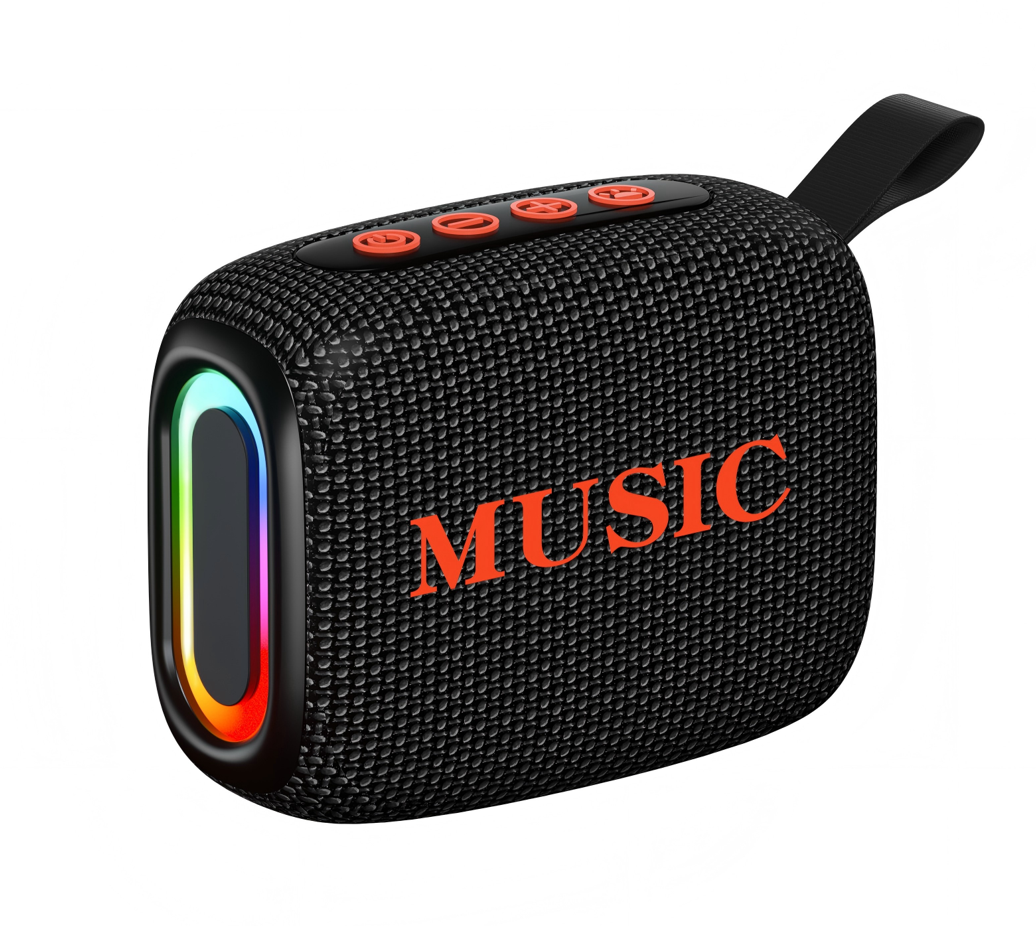
What Is a Compact Portable Bluetooth Speaker?
A compact portable Bluetooth speaker is designed around:
Small size
Lightweight portability
Personal use
Easy carrying
It may include:
One or more small drivers
Rechargeable battery
Bluetooth
TWS
RGB
Waterproofing
Strap or clip
Compact speakers are commonly used for:
Travel
Bedrooms
Small outdoor activities
Students
Gifts
Personal music
Their main strength is convenience.
What Is a High-Power Portable Bluetooth Speaker?
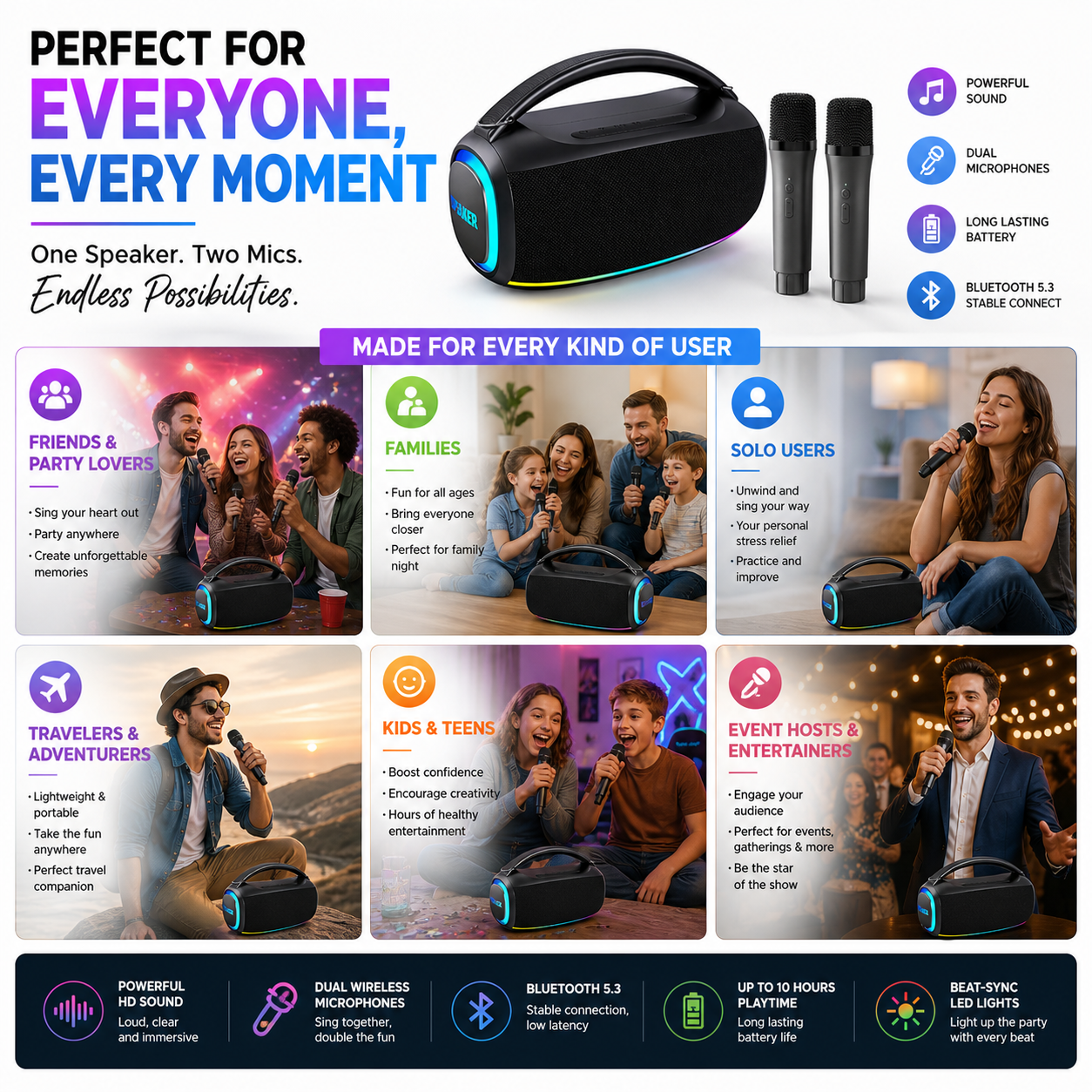
A high-power portable speaker is generally designed to provide:
Higher output
Larger sound coverage
Stronger bass
Longer outdoor use
It may include:
Larger drivers
Multiple drivers
Larger battery
Passive radiators
Stronger amplifier
RGB
Handle
Microphone support
These products are commonly used for:
Outdoor gatherings
Camping
Parties
Picnics
Family events
Larger rooms
They emphasize performance more than minimum size.
Compact vs High-Power: Quick Comparison
| Feature | Compact Speaker | High-Power Speaker |
|---|---|---|
| Size | Small | Medium to large |
| Weight | Lower | Higher |
| Portability | Excellent | Moderate to high |
| Sound output | Moderate | Higher |
| Bass potential | More limited | Greater |
| Battery space | Limited | Larger |
| Packaging volume | Lower | Higher |
| Shipping cost | Lower | Higher |
| Retail price potential | Entry to mid-range | Mid to higher |
| Outdoor coverage | Small areas | Larger areas |
| Best for | Travel / personal use | Outdoor / party use |
This comparison gives only a starting point. The final product should still be judged as a complete system.
Comparison between compact speakers and high-power
1. Target User
The first step is to identify the customer.
Compact Speaker Users
Typical users may include:
Students
Travelers
Office users
Gift buyers
Casual listeners
They may prioritize:
Portability
Affordable price
Easy charging
Compact packaging
High-Power Speaker Users
Typical users may include:
Outdoor enthusiasts
Families
Party users
Camping users
Social groups
They may prioritize:
Louder sound
Bass
Battery life
Stronger durability
The target user should determine the product direction.
2. Usage Scenario
A speaker used in a bedroom does not need the same output as a speaker used at an outdoor barbecue.
Brands should define:
Indoor or outdoor
Personal or group listening
Small or large space
Short or long usage periods
The larger the listening environment, the more important output and sound coverage may become.
3. Portability
Compact speakers are easier to:
Carry
Store
Pack
Travel with
They may fit into:
Backpacks
Handbags
Luggage
High-power speakers may still be portable, but portability often depends on:
Handle
Strap
Weight distribution
Product balance
Portable does not necessarily mean pocket-sized.
4. Product Weight
Weight affects user experience.
Compact speakers benefit from:
Lower carrying fatigue
Easier travel
High-power speakers may become heavier because of:
Larger battery
Bigger drivers
Larger housing
Brands should evaluate the final assembled weight rather than only cabinet dimensions.
5. Speaker Drivers
Compact speakers usually use smaller drivers.
High-power products may use:
Larger drivers
More drivers
Multiple acoustic elements
Larger or additional drivers can support higher output, but driver count alone does not guarantee better sound.
Performance depends on:
Driver quality
Amplifier
Cabinet
DSP
Tuning
6. Acoustic Volume
Compact speakers have limited internal space.
This limits:
Air volume
Driver size
Bass extension
High-power speakers generally provide more internal acoustic space.
This can support:
Larger drivers
Passive radiators
More complex acoustic structures
Cabinet size is therefore an important part of sound performance.
7. Bass Performance
Compact speakers can still produce satisfying bass through:
Passive radiators
DSP
Efficient acoustic design
However, physical limits remain.
High-power speakers generally provide more flexibility for:
Stronger low frequencies
Higher output
Greater bass impact
Brands should avoid unrealistic bass expectations from extremely small enclosures.
8. Wattage
Wattage is often used to compare portable speakers.
However, wattage alone can be misleading.
Actual loudness and perceived performance also depend on:
Driver efficiency
Distortion
Cabinet design
DSP
Listening distance
A well-designed lower-wattage speaker can outperform a poorly engineered product with a larger advertised number.
9. Maximum Volume
High-power speakers usually have an advantage when the user needs:
Larger sound coverage
Outdoor listening
Group entertainment
Compact speakers are generally more suitable for:
Personal listening
Small rooms
Close-range outdoor use
The correct volume target should match the intended environment.
10. Battery Capacity
Compact speakers have limited internal battery space.
High-power speakers can often support larger batteries.
However, higher-power products may also consume more energy because of:
Larger amplifier
Bigger drivers
More RGB
More functions
A larger battery does not automatically guarantee longer playback time.
11. Battery Runtime
Runtime depends on:
Battery capacity
Listening volume
Amplifier efficiency
RGB
Bluetooth
DSP
Brands should test realistic usage conditions.
For example:
A compact speaker at medium volume may run longer than a high-power speaker operated near maximum output.
Battery claims should therefore be based on defined test conditions.
12. Charging Time
Larger batteries may require longer charging times unless the charging system is designed for higher charging power.
Brands should balance:
Battery capacity
Charging speed
Thermal management
User convenience
Charging should be considered as part of the full user experience.
13. Bluetooth
Both compact and high-power portable speakers can support modern Bluetooth connectivity.
The actual connection experience depends on:
Chipset
Antenna
Firmware
PCB design
Product size alone does not determine Bluetooth performance.
14. TWS
TWS can add value to both categories.
For compact speakers, TWS can help users create:
Wider stereo
Larger sound from two small units
For high-power speakers, TWS can support:
Larger outdoor sound coverage
Bigger party setups
The feature should be tested carefully for pairing and synchronization.
15. RGB Lighting
RGB can be used in both categories.
Compact RGB Speakers
Often focus on:
Youth markets
Lifestyle
Gifts
Visual appeal
High-Power RGB Speakers
Often focus on:
Party atmosphere
Outdoor entertainment
Stronger visual impact
Larger products provide more physical space for:
Bigger lighting zones
Multiple LEDs
More complex effects
16. Waterproofing
Compact speakers are often carried more frequently and may be exposed to:
Rain
Splashes
Outdoor use
High-power speakers may also need waterproof or water-resistant structures for:
Camping
Beach
Poolside
Outdoor events
The required protection level should match the real user scenario.
17. Carry Handle vs Strap
Compact speakers often use:
Strap
Lanyard
Clip
High-power speakers more commonly use:
Integrated handle
Larger carrying structure
The carrying system should match:
Product size
Weight
Usage
Portability should be designed, not assumed.
18. Product Durability
High-power outdoor speakers may require stronger construction because they are often:
Heavier
Used outdoors
Moved frequently
Compact speakers may require good protection against:
Drops
Bag impact
Frequent handling
Durability priorities differ by category.
19. Packaging Size
Packaging is one of the biggest commercial differences.
Compact speakers generally provide:
Smaller retail boxes
Better carton utilization
Lower warehouse volume
High-power speakers require larger packaging and more protection.
This can significantly affect total logistics cost.
20. Shipping Cost
For B2B buyers, shipping cost can influence the business model as much as factory price.
Compact speakers usually provide advantages in:
Sea freight
Air freight
Parcel delivery
Warehousing
High-power speakers may have:
Larger volumetric weight
Higher actual weight
Fewer units per carton
Brands should calculate landed cost, not only unit cost.
21. Container Loading
For high-volume imports, product size affects container efficiency.
A small reduction in packaging size can increase the number of units per container.
This can be especially important for:
Distributors
Retail chains
Large importers
High-power products should therefore be optimized for packaging efficiency during product development.
22. Amazon and E-Commerce
Compact speakers can be attractive for e-commerce because they generally have:
Lower shipping volume
Easier storage
Lower parcel cost
They can also be easier to bundle or offer as gifts.
High-power speakers can still perform well online, but sellers should carefully calculate:
Fulfillment fees
Package size
Return cost
23. Retail Stores
High-power speakers may create stronger shelf presence.
Their larger size can communicate:
Power
Outdoor use
Party functionality
Compact speakers may benefit from:
Lower shelf space
Easier display
Impulse-purchase potential
Different retail channels may favor different categories.
24. Target Retail Price
Compact speakers are often positioned in:
Entry-level
Affordable lifestyle
Mid-range personal audio
High-power portable speakers may support higher retail prices because they can offer:
More output
Larger battery
More drivers
Stronger construction
More features
However, higher retail price also raises customer expectations for:
Sound
Quality
Design
Durability
25. Margin Considerations
Brands should evaluate: Factory Cost + Packaging + Freight + Duties + Fulfillment + Marketing
not only factory price.
A larger speaker may generate a higher retail price but also create higher logistics costs. A compact speaker may have a lower selling price but better shipping economics.
The most profitable product is not always the one with the highest selling price.
26. Compact Speaker OEM Strategy
Compact speaker brands should focus on:
Small footprint
Efficient acoustics
Battery efficiency
Portable carry design
Compact packaging
Useful differentiators may include:
TWS
RGB
Waterproofing
Unique shape
Strap
The goal is to create maximum user value within limited size.
27. High-Power Speaker OEM Strategy
High-power product development may focus on:
Larger drivers
Stronger amplifier
Bigger battery
Outdoor durability
Handle design
Powerful bass
Brands can also explore:
RGB
Microphone functions
TWS
depending on target users.
28. Private Label Strategy
Brands entering a new market may begin with existing ODM platforms.
For compact speakers, customization can include:
Logo
Packaging
Color
For high-power speakers, brands may additionally focus on:
Handle color
RGB
Front grille styling
This can reduce development time and risk.
29. Semi-Custom Strategy
Semi-custom development can help brands create stronger differentiation without building a completely new product.
For example:
Reuse:
PCB
Driver platform
Acoustic system
Customize:
Housing details
Carry structure
RGB
Color
Packaging
This can work well in both compact and high-power categories.
30. Full OEM Strategy
Full OEM may be appropriate when:
Sales volume is proven
Exclusive design is important
Existing products do not meet the target
Custom acoustics are needed
Development may include:
New housing
New tooling
Custom PCB
Acoustic engineering
Custom firmware
The commercial advantage should justify the investment.
How Brands Should Choose Between Compact and High-Power
A useful decision framework is:
Choose Compact When:
Travel is important
Product should fit in a bag
Shipping cost matters strongly
Target price is lower
Personal listening is the main use
E-commerce is a major channel
Choose High-Power When:
Outdoor group use is important
Stronger bass is a selling point
Larger battery is acceptable
Product weight is less critical
Party or camping use is important
Higher retail pricing is possible
Compact Speaker Product Example
A compact product concept may include:
Small full-range driver
Passive radiator
Bluetooth
TWS
USB-C charging
Strap
Basic waterproof structure
Target use:
Travel
Students
Personal outdoor use
The focus is portability and convenience.
High-Power Speaker Product Example
A larger portable product may include:
Multiple drivers
Larger passive radiators
Higher-output amplifier
Larger battery
RGB
Integrated handle
Waterproof structure
Target use:
Camping
Outdoor parties
Family gatherings
The focus is stronger audio performance and coverage.
Should a Brand Sell Both Categories?
For many brands, yes.
The two categories can serve different customers.
A simple product family could include:
Mini / Compact Speaker
For:
Personal use
Travel
Mainstream Portable Speaker
For:
General outdoor use
High-Power Outdoor Speaker
For:
Parties
Larger gatherings
This allows a brand to cover different price points.
Product Family Strategy
A brand can use common design elements across all three categories.
Examples include:
Logo position
RGB language
Grille style
Housing texture
Packaging design
This creates stronger brand recognition while serving different user groups.
Market Testing Strategy
New brands do not always need to launch both categories immediately.
A lower-risk approach may be:
Select one proven ODM model
Test customer response
Analyze sales and reviews
Expand into another size category
This helps reduce inventory risk.
What Amazon Sellers Should Consider
Amazon sellers should compare:
Selling price
Package dimensions
Fulfillment cost
Review risk
Competition
Compact speakers may provide logistics advantages.
High-power products may provide more visible differentiation.
The correct decision depends on marketplace competition and margin.
What Importers Should Consider
Importers should evaluate:
Local consumer spending
Retail channel
Shipping cost
Competitor price
Outdoor lifestyle
In some markets, affordable compact speakers may sell faster.
In others, customers may prefer larger speakers with stronger sound and visual impact.
What Retailers Should Consider
Retailers should evaluate:
Shelf space
Price point
Target customer
Product demonstration
High-power speakers may create stronger visual impact in stores.
Compact speakers allow more SKUs in limited space.
Common Selection Mistake 1: Choosing Only by Wattage
Large advertised wattage does not automatically mean a better commercial product.
Common Selection Mistake 2: Ignoring Shipping Cost
A larger product may appear profitable until freight and fulfillment are calculated.
Common Selection Mistake 3: Making Compact Speakers Too Small
Extreme miniaturization can reduce:
Sound
Battery
User satisfaction
Compact should still be practical.
Common Selection Mistake 4: Making High-Power Speakers Too Heavy
Customers may stop viewing the product as portable if carrying becomes difficult.
Common Selection Mistake 5: Using the Same Marketing for Both Categories
A compact speaker should sell:
Convenience
Travel
Everyday use
A high-power speaker should sell:
Sound
Outdoor coverage
Party experience
Different products need different positioning.
Common Selection Mistake 6: Comparing Factory Cost Without Landed Cost
A low factory price does not guarantee higher profitability. Logistics needs to be included.
🏭 Real Factory Insight
One of the most useful product-development questions is:
How far will the customer actually carry this speaker?
If the answer is:
From the desk to the bedroom.
then a medium portable product may be fine.
If the answer is:
In a backpack for several hours.
then every additional gram matters.
If the answer is:
From the car to a campsite.
then users may accept more weight in exchange for:
Stronger bass
Larger battery
Higher output
This shows why “portable” is not one product category.
It is a spectrum.
Professional OEM development starts by defining where on that spectrum the product should sit.
Buyer Decision Checklist
Before selecting compact or high-power portable speakers, confirm:
Target customer
Main usage scenario
Indoor or outdoor
Personal or group use
Target retail price
Product dimensions
Maximum acceptable weight
Driver requirement
Target output
Bass expectation
Battery target
Bluetooth requirement
TWS
RGB
Waterproofing
Carry handle or strap
Packaging size
Shipping method
Sales channel
First-order quantity
Expected annual volume
This helps manufacturers recommend the right product platform instead of simply offering the largest or smallest model.
Why Choose Shinedee
Shenzhen Shinedee Electronics develops and manufactures portable and outdoor Bluetooth speakers for brands, importers, distributors, retailers, and online sellers.
Our capabilities include:
Compact Bluetooth speaker OEM and ODM
High-power portable speaker development
Acoustic engineering
Driver selection
Passive radiator design
Battery integration
Bluetooth integration
TWS functionality
RGB customization
Waterproof structure development
Handle and strap design
Industrial design support
Product testing
Packaging customization
Quality control
Mass production
Our product categories include:
Mini Bluetooth Speakers
Compact Portable Speakers
Portable RGB Bluetooth Speakers
Outdoor Waterproof Speakers
High-Power Portable Speakers
Gaming Audio Products
Founded in 2010, Shinedee supports global customers from product selection and OEM development through acoustic tuning, sample validation, packaging, testing, quality control, and mass production.
Frequently Asked Questions
Are compact Bluetooth speakers suitable for outdoor use? Yes. Compact speakers can work well for hiking, travel, picnics, and personal outdoor listening, especially when they include durable or water-resistant designs.
Are high-power portable speakers still portable? Yes, if the weight, handle, and overall structure are designed for carrying. Portable does not always mean small.
Does a larger Bluetooth speaker always sound better? No. Larger cabinets provide more acoustic flexibility, but sound quality still depends on drivers, amplifier, DSP, cabinet design, and tuning.
Does higher wattage mean louder sound? Not always. Actual output depends on multiple factors including driver efficiency, distortion, enclosure design, and amplifier performance.
Which category is better for Amazon sellers? Compact speakers can offer shipping and fulfillment advantages, while larger products may provide stronger visual and feature differentiation. Sellers should compare total margin and competition.
Which category is better for camping? Both can work. Compact products are easier to carry, while higher-power speakers may provide stronger sound and longer battery performance for group use.
Can compact portable speakers have strong bass? They can provide satisfying bass through good acoustic design, passive radiators, and DSP, but physical enclosure size still limits low-frequency potential.
Can brands customize both compact and high-power speakers? Yes. OEM and ODM customization may include drivers, battery, Bluetooth, TWS, RGB, waterproofing, housing, carry structures, branding, and packaging.
Conclusion
Compact and high-power portable Bluetooth speakers serve different market needs.
Compact products offer advantages in:
Portability
Travel
Packaging
Shipping
E-commerce
High-power products offer advantages in:
Sound output
Bass
Battery capacity
Outdoor coverage
Party applications
The best category depends on:
Target customer
Usage scenario
Retail price
Logistics
Sales channel
Brand strategy
For many brands, the strongest long-term strategy is not choosing one category forever. It is building a product family that covers several portable-audio use cases.
Shinedee supports global customers with OEM and ODM compact and high-power portable Bluetooth speaker solutions—from product selection and acoustic engineering through battery integration, waterproof development, packaging, quality control, and mass production.