Portable Speaker With Handle vs Strap: Which Design Is Better for Outdoor Use?
Portable Speaker With Handle vs Strap: Which Design Is Better for Outdoor Use?
Introduction
Portability is one of the most important characteristics of a portable Bluetooth speaker. But “portable” can mean very different things. A compact personal speaker may need to hang from a backpack. A medium-size outdoor speaker may need to be carried from a car to a campsite. A larger portable party speaker may require a strong integrated handle.
This creates an important product-development question:
Should a portable Bluetooth speaker use a handle, a strap, or another carrying structure?
For consumers, this may appear to be a small design detail. For brands, importers, retailers, and OEM buyers, however, the carrying system can influence:
Product size
User scenario
Industrial design
Durability
Waterproof construction
Packaging
Manufacturing cost
Brand positioning
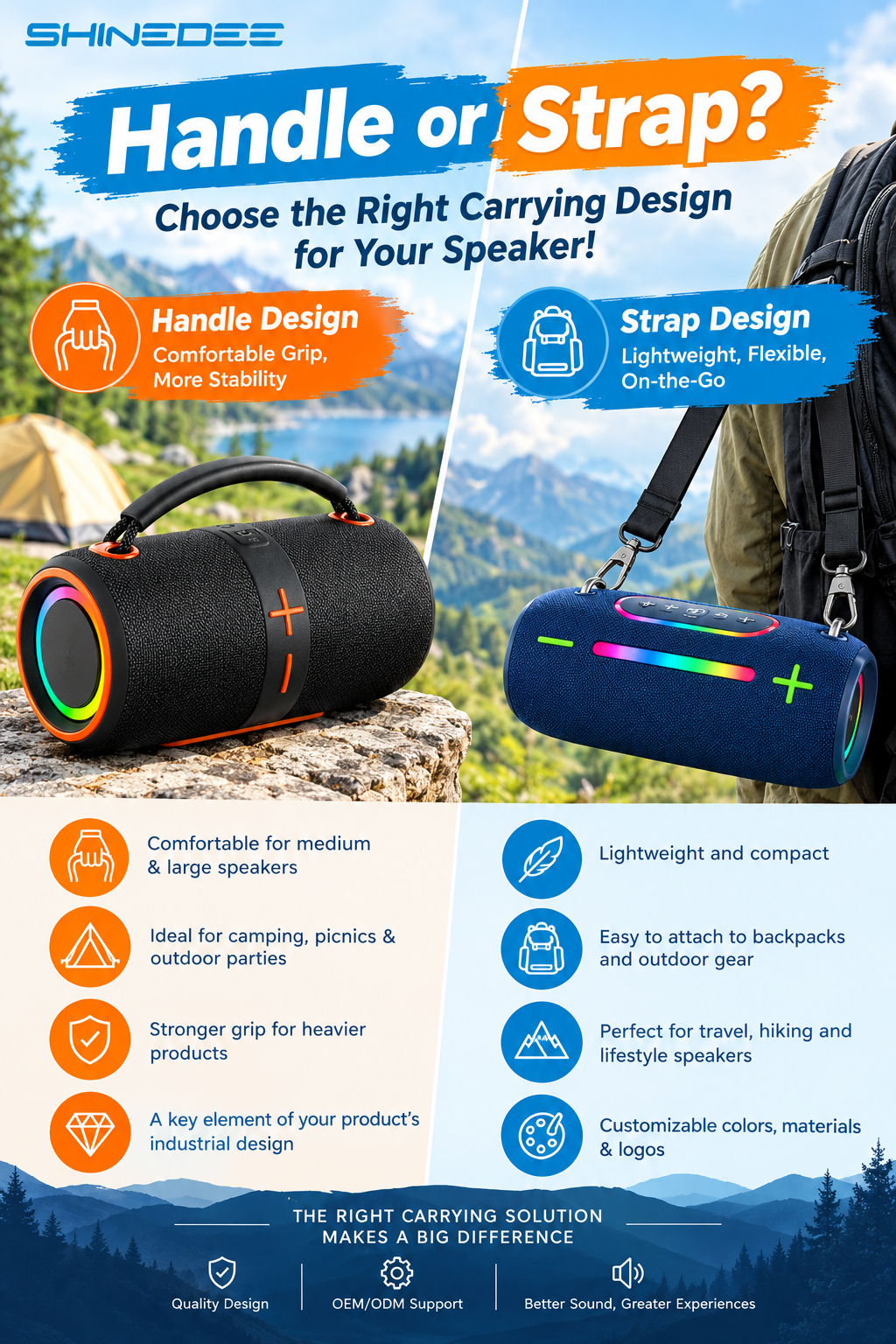
This guide compares handle and strap designs and explains how brands can choose the right carrying solution for different portable and outdoor Bluetooth speakers.
Why Carrying Design Matters
A portable speaker should be easy to move. But portability is not determined only by weight. It also depends on:
How the speaker is held
How long it will be carried
Where it will be used
Whether the user's hands need to remain free
Whether the product attaches to other equipment
A speaker can be relatively lightweight but uncomfortable to carry if the grip is poorly designed. Likewise, a slightly heavier speaker may still feel highly portable if it has a strong and comfortable handle. The carrying structure is therefore part of the user experience. This article focuses primarily on the two most common choices for mainstream portable speakers:
Handle vs Strap
What Is an Integrated Handle?
An integrated handle is built directly into the speaker housing. It may be located:
On top
On the side
Behind the enclosure
The handle may be made from:
Plastic
Rubber-coated plastic
Metal-supported structures
Multiple materials
Integrated handles are commonly used on medium and larger portable outdoor speakers.
Advantages of a Handle
1. Better for Heavier Speakers
As speaker size increases, weight also tends to increase because of:
Larger drivers
Larger batteries
Bigger cabinets
More structural materials
A strong handle can distribute this weight more comfortably. This makes handles suitable for products designed for:
Camping
Outdoor gatherings
Picnics
Parties
2. Easy Pick-Up-and-Go Use
A handle creates a clear grip point. Users can quickly:
Pick up the speaker
Move it
Put it down
This is useful for products that are moved frequently over short distances.
3. Strong Visual Identity
A handle can become part of the speaker's industrial design. Brands can use different:
Shapes
Angles
Materials
Colors
to make the product more recognizable. For some outdoor speakers, the handle becomes one of the main visual features.
4. Better Structural Integration
Because the handle is built into the housing, engineers can reinforce the structure internally. This can create a strong carrying solution when properly designed. However, the handle must still be engineered for:
Product weight
Repeated carrying
Impact
Long-term use
Limitations of Handle Designs
Handles also create trade-offs.They may increase:
Product height
Housing dimensions
Packaging size
An oversized handle can make an otherwise compact speaker less convenient to store. The handle must therefore be proportioned according to the product.
What Is a Speaker Strap?
A strap is a flexible carrying component attached to the speaker.
Possible materials include:
Fabric
Nylon
Silicone
Rubber
Braided cord
Depending on the product, the strap may be:
Fixed
Removable
Adjustable
Straps are often used on small and medium portable Bluetooth speakers.
Advantages of a Strap
1. Flexible Carrying
A strap can allow users to carry the speaker:
By hand
From a backpack
From a hook
Around the wrist
Depending on the design, some longer straps can also support shoulder carrying. This flexibility is especially useful for travel and outdoor activities.
2. Good for Compact Speakers
A strap does not need a large rigid structure. This makes it suitable for compact products where designers want to maintain a smaller overall enclosure.
3. Easier Attachment
Straps can help users attach speakers to:
Bags
Camping equipment
Bicycle accessories
Hooks
This can make the product more convenient during outdoor activities.
4. Strong Lifestyle Positioning
Fabric or colorful straps can become part of the product's aesthetic. Brands can customize:
Strap color
Material
Texture
Printed logo
This creates another opportunity for visual differentiation.
Limitations of Strap Designs
A strap is not always suitable for heavier products. As speaker weight increases, a narrow strap may become uncomfortable. The attachment point also becomes more important. If the structure is too weak, repeated pulling may damage:
Housing
Strap anchor
Fasteners
Straps must therefore be designed according to the actual speaker weight.
Handle vs Strap: Quick Comparison
| Feature | Handle | Strap |
|---|---|---|
| Best speaker size | Medium to large | Small to medium |
| Heavy product carrying | Better | More limited |
| Compact design | Moderate | Better |
| Backpack attachment | Limited | Better |
| Short-distance carrying | Excellent | Good |
| Hands-free potential | Limited | Better with long strap |
| Structural complexity | Higher | Moderate |
| Lifestyle customization | Good | Excellent |
| Packaging impact | Can increase size | Usually smaller |
| Outdoor versatility | High | High |
The correct option depends on the product concept.
Which Design Is Better for Mini Speakers?
For mini Bluetooth speakers, straps, lanyards, or clips are usually more practical.
Mini speakers are designed around:
Lightweight portability
Travel
Personal use
A large rigid handle may occupy too much space relative to the product. A small wrist strap or lanyard can preserve compact dimensions while improving portability.
Which Design Is Better for Medium Portable Speakers?
Medium-size speakers can use either solution. The choice depends heavily on the intended use.
A lifestyle-oriented product may use:
Fabric strap
Silicone strap
An outdoor-focused product may use:
Integrated handle
A medium speaker can therefore provide significant design flexibility.
Which Design Is Better for Larger Portable Speakers?
As product weight increases, handles generally become more practical.
A larger speaker may contain:
Multiple drivers
Larger passive radiators
Larger battery
A rigid handle can provide more comfortable short-distance carrying.
For heavier portable party speakers, brands may also consider:
Large handles
Shoulder straps
Multiple carrying points
depending on the product architecture.
Outdoor Camping Speakers
Camping speakers may need to move between:
Car
Tent
Table
Outdoor seating area
For medium-size camping speakers, an integrated handle can provide fast and convenient carrying.
Smaller camping speakers may benefit from straps because they can be attached to:
Backpack
Tent
Equipment
The correct design depends on whether the product is intended to be carried continuously or moved occasionally.
Hiking and Travel Speakers
Travel users often prioritize:
Low weight
Compact size
Easy bag attachment
For these products, a strap or clip can provide better portability than a large handle. The speaker should not occupy unnecessary space inside luggage.
Beach and Poolside Speakers
Beach and poolside products need to consider:
Water
Sand
Frequent handling
Wet hands
A large textured handle can make the speaker easier to grip.
Straps can also work well, but materials should be:
Water resistant
Easy to clean
Quick drying
The carrying design should be considered together with waterproof engineering.
Speaker Handle Ergonomics
A handle should be comfortable. Important factors include:
Grip width
Grip thickness
Finger clearance
Surface texture
Product balance
If the grip opening is too small, larger hands may have difficulty using it. If the handle is too thin, heavier speakers can become uncomfortable to carry.
Center of Gravity
Handle position should match the speaker's center of gravity. The internal product contains components such as:
Battery
Drivers
PCB
Passive radiators
These components may not be evenly distributed. If the handle is poorly positioned, the speaker may tilt significantly during carrying. This can make the product feel heavier and less stable.
Fixed Handle vs Folding Handle
Some portable speakers use fixed handles. Others may use folding or rotating structures.
Fixed Handle
Advantages:
Simple operation
Strong structure
Fewer moving parts
Folding Handle
Advantages:
More compact storage
Cleaner appearance when not carrying
However, folding structures require additional durability testing because moving joints introduce more potential failure points.
Speaker Strap Ergonomics
Strap Width
Strap width influences comfort. A narrow strap may be suitable for a lightweight mini speaker. A heavier speaker may require:
Wider strap
Softer material
Additional reinforcement
Brands should evaluate carrying comfort using actual production-weight samples.
Strap Length
Different strap lengths support different use cases.
Short Strap
Suitable for:
Hand carrying
Wrist use
Hanging
Longer Adjustable Strap
Suitable for:
Shoulder carrying
Cross-body carrying
The more complex the strap, the more attention should be paid to:
Buckles
Fasteners
Adjustment hardware
Removable vs Fixed Strap
Fixed Strap
Advantages:
Always available
Simple user experience
Removable Strap
Advantages:
Cleaner appearance when removed
Easier replacement
More flexible usage
A removable system requires strong attachment points.
Strap Attachment Point Design
The strap itself may be strong while the attachment point is weak. Engineers need to evaluate:
Housing thickness
Internal reinforcement
Screw structure
Metal inserts
Molded hooks
The carrying system should be designed as one complete mechanical structure.
Drop Risk
A carrying system affects the probability of accidental drops. Poor grips can cause the speaker to slip. For outdoor products, designers may use:
Textured handles
Rubberized surfaces
Wrist straps
to improve security.
Handle Materials
Common handle materials may include:
ABS
PC blends
TPE overmolding
Metal-supported structures
The selected material should balance:
Strength
Comfort
Cost
Product appearance
Strap Materials
Possible strap materials include:
Nylon
Polyester
Silicone
Rubber
Braided cord
Material choice affects:
Comfort
Strength
Water resistance
Appearance
Outdoor products should also consider UV exposure and long-term wear.
Carry Design and Waterproofing
Carrying structures can influence waterproof engineering.
A handle may create:
Additional housing joints
Screw points
A strap may require:
Attachment openings
Anchor points
These areas should not compromise the enclosure's water-resistant structure. For waterproof portable speakers, carrying features should be planned during structural design rather than added after tooling.
Carry Design and Acoustic Performance
Handles and straps may seem unrelated to sound, but industrial design changes can influence acoustic architecture.
A large integrated handle may change:
Cabinet shape
Internal volume
Passive radiator placement
A strap attachment may require internal reinforcement that occupies enclosure space. Acoustic and mechanical engineers should therefore coordinate these features.
Carry Design and Battery Placement
Portable speakers often contain relatively large rechargeable batteries.
The battery influences:
Weight distribution
Center of gravity
Internal layout
Handle position should therefore be considered together with battery placement. Good mechanical layout can make the speaker feel more balanced during carrying.
Strap Color as a Branding Tool
Straps offer a simple opportunity for customization.
Brands may use:
Signature colors
Contrasting colors
Printed logos
Woven logos
A customized strap can create differentiation without requiring a completely new speaker housing.
This can be attractive for ODM projects.
Product Color Strategy
The carrying system can also create color contrast.
For example:
Black Speaker + Orange Strap
may create an outdoor appearance.
White Speaker + Light Gray Strap
may create a lifestyle appearance.
Color combinations can help the same speaker platform target different consumer segments.
Handle and Strap Durability Testing
The carrying structure should be tested according to product weight and expected use.
Testing may evaluate:
Repeated lifting
Pulling
Twisting
Attachment strength
Material wear
The exact testing method should match the product design and customer requirements.
Why Static Load Testing Matters
A speaker may weigh only a few kilograms, but the carrying structure can experience much higher temporary force when:
Lifted quickly
Swung
Dropped while held
Testing should therefore consider more than the speaker's static weight.
Real-World Carry Testing
Engineering testing should be combined with actual user evaluation.
Ask users to:
Pick up the speaker
Walk with it
Put it down
Attach it to a bag
This can reveal ergonomic problems that mechanical drawings do not show.
Design for different market
Which Carry Design Is Better for Retail Brands?
Retail brands should consider the intended product story. Choose a handle when the main message is:
Outdoor
Powerful
Easy to carry
Choose a strap when the main message is:
Compact
Travel
Lifestyle
Flexible
The carrying system should reinforce the product positioning.
Which Carry Design Is Better for Amazon Sellers?
For online sellers, both designs can work. The key is making the benefit visually obvious. A strap can support listing images showing:
Backpack attachment
Hiking
Travel
A handle can support images showing:
Camping
Picnic
Outdoor party
Strong visual communication can improve product differentiation.
Which Design Is Better for Promotional Gifts?
For smaller promotional speakers, straps often provide good opportunities for:
Logo printing
Custom color
Compact packaging
For larger premium gift speakers, a well-designed handle can create stronger perceived value.
Which Design Is Better for Outdoor Brands?
Outdoor-focused brands may use both across different product sizes.
For example:
Mini Speaker
→ Clip or short strap
Medium Outdoor Speaker
→ Strap or integrated handle
Larger Portable Speaker
→ Strong integrated handle
This creates a logical carrying system across the product family.
Common Design Mistakes
Common Design Mistake 1: Choosing by Appearance Only: A handle may look attractive but feel uncomfortable when the final battery and drivers increase product weight. Always evaluate using realistic product weight.
Common Design Mistake 2: Weak Strap Anchors:A strong strap cannot compensate for a weak attachment structure. The entire load path needs reinforcement.
Common Design Mistake 3: Oversized Handle: An unnecessarily large handle can increase packaging volume and make the product appear bulky.
Common Design Mistake 4: Strap Too Short:A short strap may limit real outdoor use. Determine the intended carrying method before setting dimensions.
Common Design Mistake 5: Ignoring Waterproofing: Adding strap hooks or handle screws after the waterproof structure has been finalized may create new sealing challenges.
Common Design Mistake 6: Ignoring Product Balance:Poor handle location can cause the speaker to tilt while being carried.
🏭 Real Factory Insight
A carrying handle is not just a piece of plastic, and a strap is not just an accessory. Both are structural parts of the portable speaker experience. For example, imagine a speaker becomes 20% heavier after the engineering team upgrades:
Battery capacity
Driver size
The original narrow strap may now feel uncomfortable. Or imagine an integrated handle is moved slightly to improve the appearance. If that position no longer aligns with the product's center of gravity, the speaker may tilt every time the customer picks it up. These are small design decisions that can strongly affect how the product feels in real life. A professional portable speaker development process therefore evaluates:
Product Weight + User Scenario + Grip Comfort + Structural Strength + Packaging together.
Buyer Decision Checklist
Before selecting a carrying design, confirm:
Product size
Final product weight
Battery weight
Target customer
Main outdoor scenario
Carrying distance
Backpack attachment requirement
Handle or strap preference
Grip comfort
Center of gravity
Waterproof requirement
Material
Color
Logo customization
Packaging dimensions
Durability requirements
First-order quantity
Target retail price
A clear user scenario makes the carrying-design decision much easier.
Why Choose Shinedee
Shenzhen Shinedee Electronics develops and manufactures portable and outdoor audio products for brands, importers, distributors, retailers, and online sellers.
Our capabilities include:
Portable Bluetooth speaker OEM and ODM
Outdoor speaker development
Carry-handle structure development
Strap and portability design
Industrial design support
Mechanical engineering
Acoustic engineering
Battery integration
Bluetooth integration
RGB customization
Waterproof structure development
Product testing
Packaging customization
Quality control
Mass production
Our product categories include:
Portable Bluetooth Speakers
Mini Bluetooth Speakers
Portable RGB Speakers
Outdoor Waterproof Speakers
RGB Gaming Speakers
Gaming Soundbars
Founded in 2010, Shinedee supports customers from product concept and structural development through acoustic engineering, sample validation, testing, packaging, and mass production.
Frequently Asked Questions:
Is a handle or strap better for a portable Bluetooth speaker? It depends on product size, weight, and usage. Handles are generally better for medium and larger speakers, while straps are often more suitable for smaller and lightweight portable speakers.
Are straps suitable for outdoor speakers?:Yes. Straps can be useful for travel, hiking, camping, and backpack attachment when the speaker weight and attachment structure are suitable.
Are handles better for heavy Bluetooth speakers?: Generally, a properly designed handle can provide more comfortable carrying for heavier products, especially over short distances.
Can a Bluetooth speaker have both a handle and a strap?:Yes. Some products can support both, although the additional structure and cost should create a clear user benefit.
Can the speaker strap be customized?:Yes. Depending on the project, brands may customize strap color, material, length, logo, and attachment design.
Can the handle be customized for an OEM speaker?:Yes. Full OEM development can include custom handle shape, texture, materials, color, branding, and structural integration.
Does adding a handle affect speaker packaging?:It can. A fixed handle may increase overall dimensions and therefore increase retail-box and master-carton volume.
Can a handle affect waterproofing?:Potentially. Handle attachment points and housing interfaces should be considered during waterproof structural development.
How should brands test a speaker handle or strap?:Testing may include repeated carrying, pulling, twisting, attachment-strength testing, and real-user evaluation according to the speaker's weight and intended application.
Which design is best for a mini Bluetooth speaker?:For very compact products, a strap, lanyard, or clip is often more space-efficient than a large rigid handle.
Conclusion
The carrying system is an important part of portable Bluetooth speaker design.
A strap can provide:
Compactness
Flexible attachment
Travel convenience
Lifestyle differentiation
A handle can provide:
Stronger support
Easier short-distance carrying
Better ergonomics for heavier products
Strong outdoor product identity
Neither solution is universally better.
The correct choice depends on:
Product size
Weight
Target customer
Outdoor scenario
Waterproofing
Industrial design
Packaging
Cost
For brands developing a portable speaker, carrying design should be considered early together with acoustic architecture, battery placement, mechanical structure, and product positioning. Shinedee supports global customers with OEM and ODM portable Bluetooth speaker development, including handle and strap design, acoustic engineering, battery integration, waterproof structures, RGB customization, product testing, packaging, and mass production.